

What happens when artificial intelligence moves from something businesses experiment with to something that fundamentally changes how people work?
That question was at the center of Questrom School of Business’s AI & The Next Economy, an Entrepreneur Events program that brought together members of the Questrom community and business leaders to explore how organizations can navigate an increasingly AI-enabled workplace.
Hosted by Entrepreneur magazine’s Editor In Chief Jason Feifer, the event looked beyond what AI can do to explore what its growing presence means for the people using it—and how businesses can adapt their strategies, teams, and workplaces in response.
Throughout the day, conversations touched on AI strategy, automation, training, team dynamics, workforce transformation, and the changing relationship between people and technology. From opening remarks and keynotes to hands-on breakout sessions and an AI showcase, the event encouraged attendees to think beyond AI experimentation and toward what it takes to make the technology work in practice.
Setting the Stage for AI in Practice
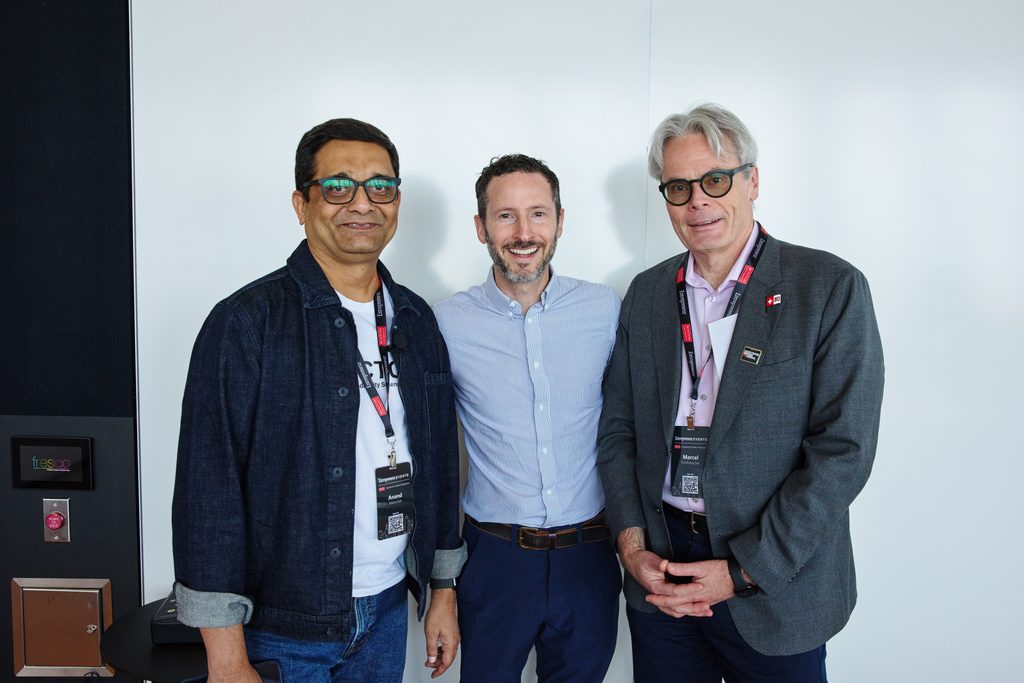
Questrom’s Interim Dean Marcel Rindisbacher helped set the tone for the event during the opening session, encouraging attendees to think beyond AI as a technology and consider how it can translate into meaningful value for businesses and organizations.
The program then turned to the question of how businesses can move from experimentation to transformation.
Anand Mahurkar, Founder and CEO of Findability Sciences, shared a keynote focused on the challenges organizations face when moving AI initiatives forward. Rather than treating AI adoption as simply a question of choosing the right technology, Mahurkar emphasized the importance of determining who owns the workflow once AI becomes part of it. His perspective highlighted the organizational decisions that can determine whether an AI initiative ultimately creates lasting value.
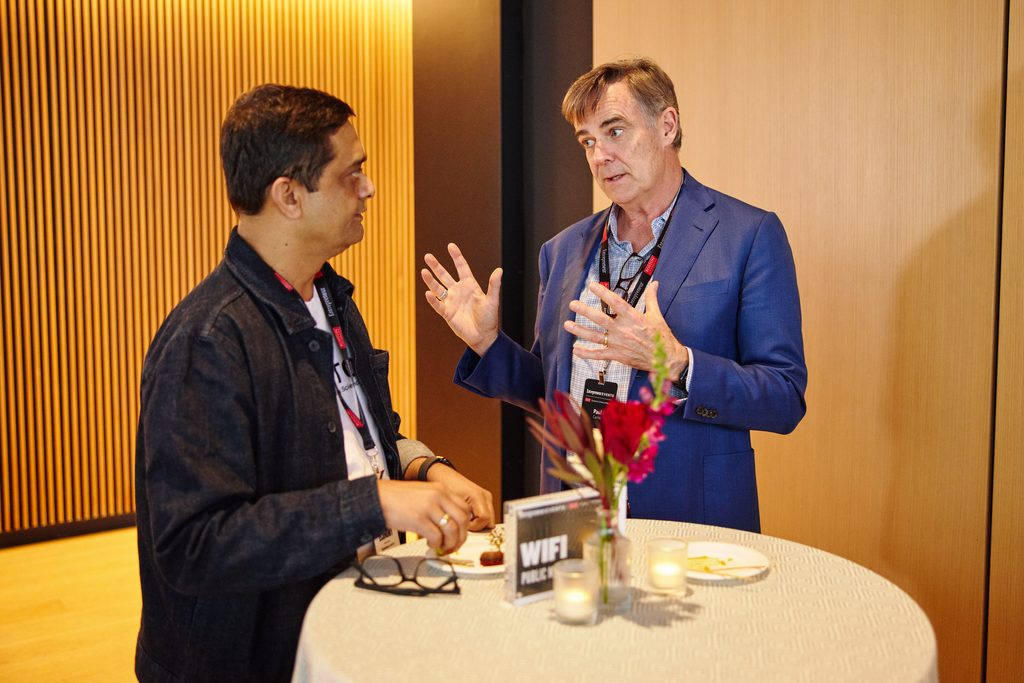
The conversation continued in a live case led by Sam Goldberg, Co-Founder, Chief Strategy Officer and General Counsel at Unburdn.ai, and Paul Carlile, Peter and Deborah Wexler Professor of Management and Information Systems and Senior Associate Dean for Research and Innovation.
Working through a real business case in real time, Goldberg and Carlile explored the questions organizations must consider when moving an AI idea toward implementation — from identifying the business objective and relevant AI capabilities to understanding organizational constraints, data requirements, trade-offs, risks, and next steps.
Carlile’s focus on putting AI into practice also reflects Questrom’s approach to educating future business leaders. In his work on curricular innovation, Carlile helped launch the Online Master’s in AI in Business, which takes a business problem-first approach to understanding how AI can create value. The program emphasizes human-AI collaboration, implementation, and the organizational structures needed to use AI effectively and responsibly.
Together, the opening sessions established a theme that carried throughout the rest of the event: understanding AI is only the beginning. The larger challenge is figuring out how people and organizations can use it effectively.
From AI Tools to Organizational Change
As the day continued, the conversation expanded beyond individual AI tools and toward the broader question of how technology changes organizations.
Adopting AI is not simply a matter of introducing a new technology. It can affect how teams collaborate, how employees approach their work, what skills organizations prioritize, and where human judgment remains essential.
The breakout sessions gave attendees an opportunity to explore those questions from different perspectives.
In “Everything You Learned About Prompting Is Wrong,” Sam Goldberg and H. Sami Karaca, Clinical Assistant Professor in Markets, Public Policy & Law and Faculty Director of the Online MS in AI in Business, explored how people can work more effectively with today’s AI models. Rather than focusing on rigid formulas for writing prompts, the session emphasized clearly communicating the problem, providing useful context, defining what success looks like, and working iteratively with AI.
Another session, “From Pilot to P&L,” focused on what happens after an organization has experimented with AI. Led by Mahurkar and Venkat Venkatraman, Professor Emeritus in Information Systems, the session examined how leaders can determine which AI initiatives are ready to scale, integrate them into existing operating models, redesign workflows and decision rights, and establish meaningful measures of performance.
The activity reflected a larger theme of the event: learning about AI requires doing, not just observing. Moving from an AI pilot to sustained business value requires experimentation, organizational change, and a clear understanding of how technology fits into the way people actually work.
Reclaiming Agency in an AI-Enabled Workplace
That focus on implementation also connected to a broader conversation about agency.
Rather than viewing AI as something that simply happens to employees, the event encouraged participants to consider how they can actively shape their relationship with the technology. Reclaiming agency emerged as an important theme in considering what an AI-enabled workplace might look like.
For leaders, that can mean making intentional decisions about organizational design, workforce development, and where AI belongs within existing workflows. For employees, it can mean developing the confidence and skills to work alongside AI while continuing to bring human judgment, experience, and perspective to their work.
Those questions came into focus during “Leading an AI-Confident Workforce,” facilitated by Michel Anteby, Professor of Management and Organizations at Questrom and Professor of Sociology at Boston University’s College of Arts and Sciences. The session examined the human side of AI adoption, including communication, learning, trust, accountability, job redesign, accuracy, privacy, fairness, and professional identity.
Together, the breakout conversations showed that successful AI adoption involves much more than technology. It also requires organizations to consider how work changes, how employees learn, and how leaders build confidence and trust during periods of transformation.
Connecting AI With Real-World Challenges
Throughout the day, attendees had opportunities to engage with AI from multiple perspectives through interactive sessions, expert insights, working breakout sessions, and an AI in Action Showcase.
The event’s practical focus encouraged participants to move beyond broad predictions about AI and consider the decisions organizations are facing now: Which problems are worth solving with AI? Who is responsible for the resulting workflows? How should work be redesigned? What skills will employees need? And how can organizations measure whether an AI initiative is actually creating value?
The AI in Action reception and showcase provided an opportunity to continue those conversations while seeing AI applications in practice and connecting with other attendees.
Looking Ahead
By the end of AI & The Next Economy, the conversation had moved well beyond the capabilities of the technology itself. AI may continue to evolve rapidly, but its impact will ultimately depend on how people and organizations choose to work with it.
For businesses, that means thinking strategically about implementation while giving employees the training, structure, and space to experiment. For individuals, it means developing the ability to adapt, ask thoughtful questions, and make informed decisions about when AI can enhance their work.
The event offered the Questrom community an opportunity to think critically about that transition — not simply asking what the next economy will look like, but considering how people and organizations can help shape it.