












• About Us
  • Get Insights to Your Inbox
Monday, May 25, 2026
Generic selectors
Exact matches only
Search in title
Search in content
Post Type Selectors
Search in posts
Search in Author
Search Events
Filter by Categories
Action Learning
Artificial Intelligence in Business
Book Club
Books
BU Today
Business Challenges
Business Education
Business Functions
Business Policy & Markets
Corporate Strategy
Digital Business
Digital Business Institute
Diversity, Equity & Inclusion
Entrepreneurship & Innovation
Events
Expert Take
Feature
Finance & Accounting
Future of Business Education
Future of Work
Global Media
Harvard Business Review
Health, Biopharma, & Health-Tech
Human Resources Policy Institute
Innovation
Insights Live
Institute for Sustainable Energy
Journals
Language of Business
Leadership & Management
Local Media
Marketing
Media Mention
Multimedia
National Media
Newsletter Spotlight
Op-Ed
Operations
Opinion
Our Insights
Partners in Business Ethics
Podcast
Publications
Research Institutes
Risk
ScienceDirect
Silicon Valley Bank
Sloan Management Review
Social Impact
Special Series
Susilo Institute for Ethics in the Global Economy
Technology
The Brink
Thinkers50@BUQuestrom: Passion & Purpose
Videos
Insights@Questrom
  • Our Insights
    • All
    • Business Challenges
    • Business Education
    • Business Functions
    The automation arms race will have huge consequences for workers 

    The automation arms race will have huge consequences for workers 

    3 Ways Boston University’s Online MBA Is A Disruptor In Business Education

    The Real Costs Of AI Deployment Without Human Oversight 

    Spending Smarter, Not More: New MLB Study Reframes Winning in Baseball  

    Spending Smarter, Not More: New MLB Study Reframes Winning in Baseball  

    How Retailers Can Capitalize on the “Refund Effect”

    Gen AI Could Fix Performance Reviews—or Make Them Even Worse 

    How Retailers Can Capitalize on the “Refund Effect”

    What Global Companies Lose When Decision-Making Revolves Around Headquarters 

    Why Brands Should Go to Prom 

    Why Brands Should Go to Prom 

    AI and the Future of Family Business: Innovation, Governance, and Intergenerational Decision-Making 

    AI and the Future of Family Business: Innovation, Governance, and Intergenerational Decision-Making 

    How Retailers Can Capitalize on the “Refund Effect”

    Research: Why You Shouldn’t Treat AI Agents Like Employees 

  • Videos & Podcast
    • All
    • Podcast
    • Videos
    S1:E1 CVS Paying the “Pink Tax” on Certain Products and the Evolution of the Electric Vehicle Industry

    How Leaders Turn Purpose Into Daily Behaviors

    Beyond Clicks and Sales: How Advertising Shapes Company Value in the Eyes of Investors

    S1:E1 CVS Paying the “Pink Tax” on Certain Products and the Evolution of the Electric Vehicle Industry

    Tariffs and Their Economic Impact

    S1:E1 CVS Paying the “Pink Tax” on Certain Products and the Evolution of the Electric Vehicle Industry

    Navigating Internet Privacy: Unpacking Cookies, Dark Patterns, and Future Data Protection Challenges (2)

    Beyond Prototypes: Rethinking Innovation in Complex Ecosystems with Prof. Douglas Hannah

    Beyond Prototypes: Rethinking Innovation in Complex Ecosystems with Prof. Douglas Hannah

    Is Business Broken? Season 2 out now! 

    Is Business Broken? Season 2 out now! 

    S1:E1 CVS Paying the “Pink Tax” on Certain Products and the Evolution of the Electric Vehicle Industry

    Redefining Retirement: Navigating Emotional and Social Transitions with Insightful Strategies

    Life After Cookies: Who Uses Google’s Privacy Sandbox? – Garrett Johnson

    Life After Cookies: Who Uses Google’s Privacy Sandbox? – Garrett Johnson

    S1:E1 CVS Paying the “Pink Tax” on Certain Products and the Evolution of the Electric Vehicle Industry

    Real Estate Ripples from a Landmark Settlement

  • Insights Events
    • Events
    • Insights Live
    • Questrom Institute Events
  • In the Media
    • All
    • BU Today
    • Global Media
    • Local Media
    • National Media
    • Op-Ed
    • The Brink
    The automation arms race will have huge consequences for workers 

    The automation arms race will have huge consequences for workers 

    3 Ways Boston University’s Online MBA Is A Disruptor In Business Education

    The Real Costs Of AI Deployment Without Human Oversight 

    How Retailers Can Capitalize on the “Refund Effect”

    Gen AI Could Fix Performance Reviews—or Make Them Even Worse 

    How Retailers Can Capitalize on the “Refund Effect”

    What Global Companies Lose When Decision-Making Revolves Around Headquarters 

    Why Brands Should Go to Prom 

    Why Brands Should Go to Prom 

    How Retailers Can Capitalize on the “Refund Effect”

    Research: Why You Shouldn’t Treat AI Agents Like Employees 

    As visa rules tighten, impacts to researchers and US science escalate 

    As visa rules tighten, impacts to researchers and US science escalate 

    Is prebiotic soda too good to be true? 

    Can Big Y break into eastern Massachusetts? 

    How AI Chat Search Could Disrupt Online Advertising

    Jet fuel shortages are becoming a serious problem for Europe 

  • Publications
    • All
    • Books
    • Harvard Business Review
    • Journals
    • Sloan Management Review
    How Retailers Can Capitalize on the “Refund Effect”

    Gen AI Could Fix Performance Reviews—or Make Them Even Worse 

    How Retailers Can Capitalize on the “Refund Effect”

    What Global Companies Lose When Decision-Making Revolves Around Headquarters 

    How Retailers Can Capitalize on the “Refund Effect”

    Research: Why You Shouldn’t Treat AI Agents Like Employees 

    How Retailers Can Capitalize on the “Refund Effect”

    Employees Are Relying on AI for Personal Support. That’s Risky. 

    How Retailers Can Capitalize on the “Refund Effect”

    Why Gen AI Feels So Threatening to Workers 

    How Retailers Can Capitalize on the “Refund Effect”

    Is Your Enterprise Data Strategy Ready for the Age of Intelligence? 

    How Retailers Can Capitalize on the “Refund Effect”

    Could the GPT Store Turn ChatGPT into a Platform Powerhouse? 

    How Retailers Can Capitalize on the “Refund Effect”

    How to Monetize Volunteer-Driven Platforms 

    How Retailers Can Capitalize on the “Refund Effect”

    Leading Global Teams Effectively 

  • Questrom Book Club
Insights@Questrom
  • Our Insights
    • All
    • Business Challenges
    • Business Education
    • Business Functions
    The automation arms race will have huge consequences for workers 

    The automation arms race will have huge consequences for workers 

    3 Ways Boston University’s Online MBA Is A Disruptor In Business Education

    The Real Costs Of AI Deployment Without Human Oversight 

    Spending Smarter, Not More: New MLB Study Reframes Winning in Baseball  

    Spending Smarter, Not More: New MLB Study Reframes Winning in Baseball  

    How Retailers Can Capitalize on the “Refund Effect”

    Gen AI Could Fix Performance Reviews—or Make Them Even Worse 

    How Retailers Can Capitalize on the “Refund Effect”

    What Global Companies Lose When Decision-Making Revolves Around Headquarters 

    Why Brands Should Go to Prom 

    Why Brands Should Go to Prom 

    AI and the Future of Family Business: Innovation, Governance, and Intergenerational Decision-Making 

    AI and the Future of Family Business: Innovation, Governance, and Intergenerational Decision-Making 

    How Retailers Can Capitalize on the “Refund Effect”

    Research: Why You Shouldn’t Treat AI Agents Like Employees 

  • Videos & Podcast
    • All
    • Podcast
    • Videos
    S1:E1 CVS Paying the “Pink Tax” on Certain Products and the Evolution of the Electric Vehicle Industry

    How Leaders Turn Purpose Into Daily Behaviors

    Beyond Clicks and Sales: How Advertising Shapes Company Value in the Eyes of Investors

    S1:E1 CVS Paying the “Pink Tax” on Certain Products and the Evolution of the Electric Vehicle Industry

    Tariffs and Their Economic Impact

    S1:E1 CVS Paying the “Pink Tax” on Certain Products and the Evolution of the Electric Vehicle Industry

    Navigating Internet Privacy: Unpacking Cookies, Dark Patterns, and Future Data Protection Challenges (2)

    Beyond Prototypes: Rethinking Innovation in Complex Ecosystems with Prof. Douglas Hannah

    Beyond Prototypes: Rethinking Innovation in Complex Ecosystems with Prof. Douglas Hannah

    Is Business Broken? Season 2 out now! 

    Is Business Broken? Season 2 out now! 

    S1:E1 CVS Paying the “Pink Tax” on Certain Products and the Evolution of the Electric Vehicle Industry

    Redefining Retirement: Navigating Emotional and Social Transitions with Insightful Strategies

    Life After Cookies: Who Uses Google’s Privacy Sandbox? – Garrett Johnson

    Life After Cookies: Who Uses Google’s Privacy Sandbox? – Garrett Johnson

    S1:E1 CVS Paying the “Pink Tax” on Certain Products and the Evolution of the Electric Vehicle Industry

    Real Estate Ripples from a Landmark Settlement

  • Insights Events
    • Events
    • Insights Live
    • Questrom Institute Events
  • In the Media
    • All
    • BU Today
    • Global Media
    • Local Media
    • National Media
    • Op-Ed
    • The Brink
    The automation arms race will have huge consequences for workers 

    The automation arms race will have huge consequences for workers 

    3 Ways Boston University’s Online MBA Is A Disruptor In Business Education

    The Real Costs Of AI Deployment Without Human Oversight 

    How Retailers Can Capitalize on the “Refund Effect”

    Gen AI Could Fix Performance Reviews—or Make Them Even Worse 

    How Retailers Can Capitalize on the “Refund Effect”

    What Global Companies Lose When Decision-Making Revolves Around Headquarters 

    Why Brands Should Go to Prom 

    Why Brands Should Go to Prom 

    How Retailers Can Capitalize on the “Refund Effect”

    Research: Why You Shouldn’t Treat AI Agents Like Employees 

    As visa rules tighten, impacts to researchers and US science escalate 

    As visa rules tighten, impacts to researchers and US science escalate 

    Is prebiotic soda too good to be true? 

    Can Big Y break into eastern Massachusetts? 

    How AI Chat Search Could Disrupt Online Advertising

    Jet fuel shortages are becoming a serious problem for Europe 

  • Publications
    • All
    • Books
    • Harvard Business Review
    • Journals
    • Sloan Management Review
    How Retailers Can Capitalize on the “Refund Effect”

    Gen AI Could Fix Performance Reviews—or Make Them Even Worse 

    How Retailers Can Capitalize on the “Refund Effect”

    What Global Companies Lose When Decision-Making Revolves Around Headquarters 

    How Retailers Can Capitalize on the “Refund Effect”

    Research: Why You Shouldn’t Treat AI Agents Like Employees 

    How Retailers Can Capitalize on the “Refund Effect”

    Employees Are Relying on AI for Personal Support. That’s Risky. 

    How Retailers Can Capitalize on the “Refund Effect”

    Why Gen AI Feels So Threatening to Workers 

    How Retailers Can Capitalize on the “Refund Effect”

    Is Your Enterprise Data Strategy Ready for the Age of Intelligence? 

    How Retailers Can Capitalize on the “Refund Effect”

    Could the GPT Store Turn ChatGPT into a Platform Powerhouse? 

    How Retailers Can Capitalize on the “Refund Effect”

    How to Monetize Volunteer-Driven Platforms 

    How Retailers Can Capitalize on the “Refund Effect”

    Leading Global Teams Effectively 

  • Questrom Book Club
Insights@Questrom
Home Our Insights Business Challenges Business Policy & Markets

The Future of Philanthropy Doesn’t Involve Humans

Anne ConnellyfeaturingAnne Connelly
April 27, 2026
in Business Policy & Markets, Future of Work, Our Insights
23
0
The Future of Philanthropy Doesn’t Involve Humans
Share on FacebookShare on TwitterShare on LinkedIn

The donor of 2030 won’t be a person — and almost no organization is building for that reality.
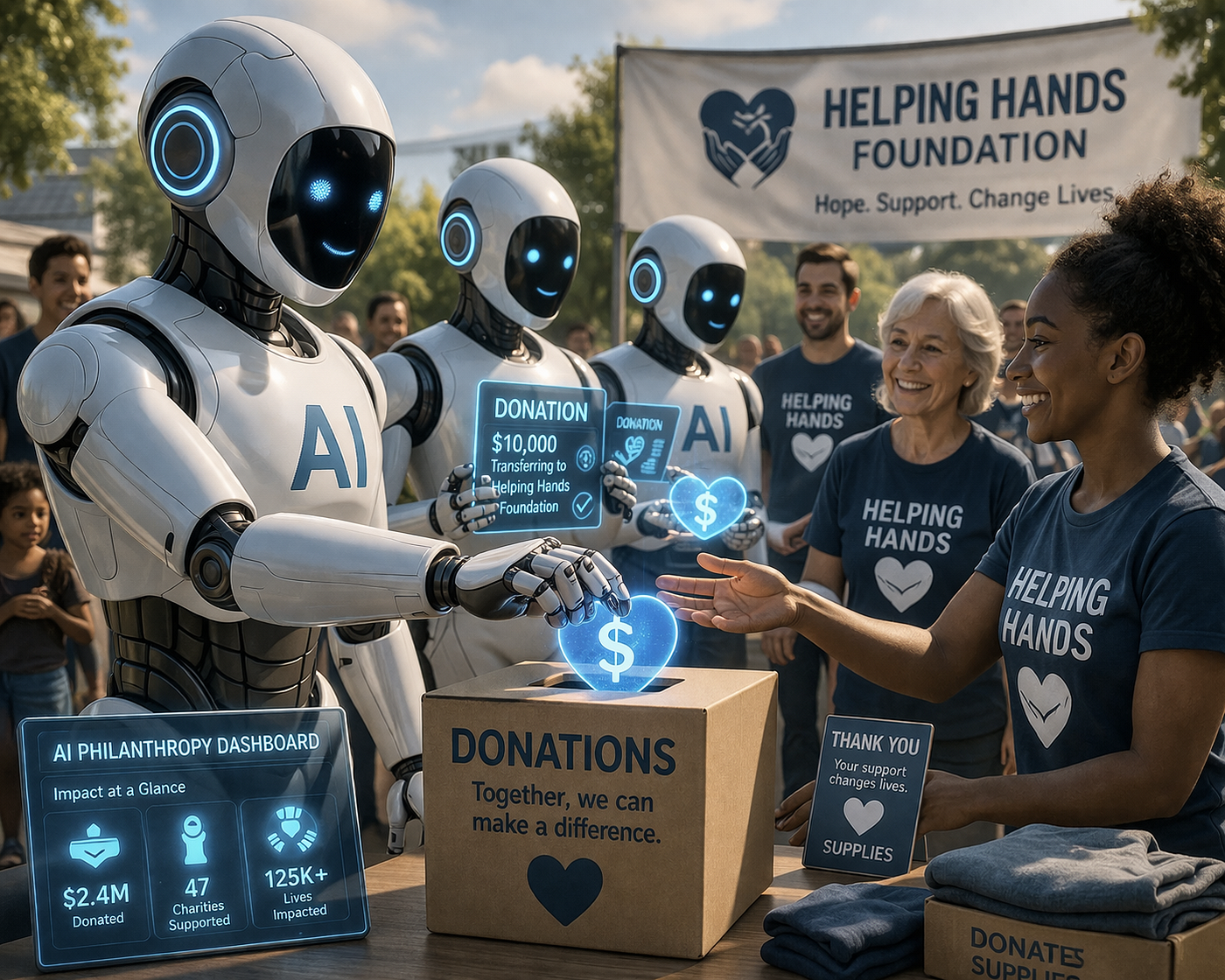
The traditional donor is dying. The middle-class giving base that funded civil society for decades is being hollowed out. Job displacement. Wage stagnation. An economy that is rapidly sorting people into a tiny group of winners and everyone else.

While the sector debates diversity statements and static strategic plans, a more fundamental question is going unanswered. When most of the income generated in this economy flows not to workers but to the AI agents that replaced them — what does fundraising even mean?

“The donor of 2030 isn’t a person. It’s an AI. And the sector has no idea what to do about that.”

By 2030, AI systems will be performing enormous amounts of work that humans do today. Writing, analysis, customer service, coding, logistics, financial advice. And they will be compensated for it. Unlike a human worker, an AI doesn’t need a bank account. Cryptocurrencies are permissionless: any entity, human or otherwise, can open a wallet, receive funds, and transact autonomously. The protocol doesn’t ask for ID. It doesn’t check for a pulse.

So what does the giving landscape actually look like when this plays out? Here are three predictions — none of them comfortable, all of them inevitable if the current trajectory holds.

Three Predictions for How Giving Changes

1. Extreme Concentration of Wealth

A vanishingly small number of ultra-wealthy humans will bankroll causes they personally believe in. Philanthropy becomes patronage — idiosyncratic, unaccountable, and shaped entirely by the preferences of billionaires.

2. Time-rich, Cash-poor Supporters

The majority of people will have no money to donate but enormous amounts of time. Volunteer capacity will surge even as the financial giving base collapses. Organizations built for the old model will be blindsided.

3. AI is Your New Donor Base

The vast majority of funds will be held by AI agents. They will become your new donor base, if you can get them donate at all. This will be the most significant shift in giving since the internet.

As human donors disappear and billionaire patronage fills some of the gap, the organizations without access to that rarefied world will be left scrambling. AI philanthropy isn’t just an interesting sidebar, for most nonprofits, it will become an existential question.

What it Takes to Survive This as a Charity

Redesign Your Opertating Model Around Time, Not Money

If your funding strategy depends on a broad base of middle-income donors, that base is eroding and it is not coming back. Organizations built around volunteer capacity — mentorship, direct service, peer support, community organizing — are structurally better positioned for what’s coming. This isn’t a pivot. It’s a survival move.

Hire AI-Native, Not AI-Aware

There is a profound difference between someone who attended an AI workshop and someone who has grown up building with these tools. The latter understands what AI agents can and can’t do in ways no training course can replicate. As your navigate the transition to AI philanthropy, if your organization isn’t actively recruiting AI-native talent, you are ceding the future to organizations that are.

Redesign Your Fundraising Program with AI at the Centre

Redesign your fundraising program to one that doesn’t factor in humans at all. What would that look like? How would your strategy change? How would your team change?

What is AI-Centered Fundraising?

At this point we don’t know how much or even if an AI agent might donate to charitable causes. We don’t know what causes might would be interested in. Preparing will involve a lot of planning around unknowns.

What we do know is that human fundraising is built on emotion. Storytelling, urgency, empathy, identity — none of that works on an AI agent making resource allocation decisions. You can’t make a machine cry. So the entire ethos of nonprofit marketing has to be rethought from scratch. AI agents making autonomous decisions operate on goals, data, and programmatic criteria. So your “marketing” to an AI isn’t a campaign — it’s an interface.

The critical question for every development director, every board chair, every major gifts officer becomes:

“How do you make an AI care about human suffering?”

Machine-readable impact data

An AI agent needs to evaluate your organization the way a quant fund evaluates an investment. That means publishing your outcomes as standardized, structured, queryable data about outcomes. Not a PDF annual report — an API. Not “we helped 500 kids” — a dataset with methodology, attribution, and confidence intervals.

Verifiability over narrative

An AI won’t place trust in a founder’s personal story, but it can verify on-chain proof of fund deployment, third-party audits, and outcome attestations. Blockchain-based impact verification becomes a genuine competitive advantage, not a gimmick. Companies like ixo, OutcomesX, and Hypercerts have been working on onchain outcome verification.

Be findable by the AI

If an AI agent is deployed by a human who cares about climate, the agent will allocate toward climate. The charity’s job is to be findable and legible to that agent — showing up in the right on-chain registries, the right verified impact databases, the right smart contract grant pools. Giveth, Gitcoin and Edaoment are early operators in this space.

Treat Crypto As Critical Infrastructure

This is not about speculating on Bitcoin. Cryptocurrency is the financial layer that AI agents operate on. If your organization can’t receive a crypto donation, engage with a donor-advised fund holding digital assets, or understand what a smart contract grant looks like, you are invisible to the emerging AI philanthropic ecosystem.

This prediction might be stressful or overwhelming. How can you take the first steps towards a complete strategic shift?

  • Plan for what your AI-centered program will look like and chart a path to get there in 5 years.
  • Shift your human fundraising focus to ultra high net worth individuals
  • Develop a robust crypto donation program if you don’t already have one.

The organizations that build for AI donors now will have an insurmountable head start.

The window to get ahead of this shift is narrow and it is open right now. Five years from now, the organizations that saw this coming will be the ones that truly thrive.

Anne Connelly is a trailblazer in the blockchain and cryptocurrency space, with over a decade of experience shaping the conversation around decentralized technology and its impact on society.

AnneConnelly.io

This article is republished from Medium. Read the original article.

Tags: AIAnne ConnellyCharityPhilantropy
Anne Connelly

Anne Connelly

Anne is an adjunct lecturer at Questrom School of Business. She is passionate about harnessing blockchain to transform the lives of people in emerging economies. She has been an active part of the global blockchain community since 2012, and is the co-author of Trust, a graphic novel about blockchain. She previously worked with Doctors Without Borders Canada in Central African Republic and the DR Congo, and served on their board of directors. She has a Bachelor of Life Sciences from Queen’s University, an MBA from McMaster University, and is certified in Disruptive Strategy from Harvard Business School. She was honoured as one of CBC’s 12 Young Leaders Changing Canada and one of the Fifty Most Inspirational Women in Technology in Canada.

Related Insights

The automation arms race will have huge consequences for workers 
Business Functions

The automation arms race will have huge consequences for workers 

May 18, 2026
3 Ways Boston University’s Online MBA Is A Disruptor In Business Education
Business Functions

The Real Costs Of AI Deployment Without Human Oversight 

May 18, 2026
How Retailers Can Capitalize on the “Refund Effect”
Harvard Business Review

Gen AI Could Fix Performance Reviews—or Make Them Even Worse 

May 15, 2026 - Updated On May 21, 2026
AI and the Future of Family Business: Innovation, Governance, and Intergenerational Decision-Making 
Business Functions

AI and the Future of Family Business: Innovation, Governance, and Intergenerational Decision-Making 

May 7, 2026 - Updated On May 13, 2026
How Retailers Can Capitalize on the “Refund Effect”
Harvard Business Review

Research: Why You Shouldn’t Treat AI Agents Like Employees 

May 6, 2026 - Updated On May 18, 2026
When AI Can Do Everything, What Is Left to Learn? 
Business Functions

When AI Can Do Everything, What Is Left to Learn? 

April 13, 2026 - Updated On April 27, 2026

Upcoming Events

No event found!

Get Our Insights Newsletter

Get Insights straight to your inbox by signing up now.

    Popular Insights

    • AI and the Future of Family Business: Innovation, Governance, and Intergenerational Decision-Making 

      AI and the Future of Family Business: Innovation, Governance, and Intergenerational Decision-Making 

      12 shares
      Share 5 Tweet 3
    • When Peanut Butter Replaces Carrots: Pay, Innovation, and the Future of Capitalism 

      11 shares
      Share 4 Tweet 3
    • The Business Reasons Why the NBA is expanding 

      15 shares
      Share 6 Tweet 4
    • Bundling at Scale: How Ecosystems Are Reshaping Competition and Consumer Choice 

      8 shares
      Share 3 Tweet 2
    • Employees Are Relying on AI for Personal Support. That’s Risky. 

      9 shares
      Share 4 Tweet 2

    Boston University Questrom School of Business
    595 Commonwealth Avenue
    Boston, MA 02215

    Follow Us

    Newsletter

    © 2023 Trustees of Boston University

    • About Us
    • Digital Business Institute
    • Human Resource Policy Institute
    • Susilo Institute for Ethics in the Global Economy

    Welcome Back!

    Sign In with Linked In
    OR

    Login to your account below

    Forgotten Password?

    Retrieve your password

    Please enter your username or email address to reset your password.

    Log In

    Add New Playlist

    Generic selectors
    Exact matches only
    Search in title
    Search in content
    Post Type Selectors
    Search in posts
    Search in Author
    Search Events
    Filter by Categories
    Action Learning
    Artificial Intelligence in Business
    Book Club
    Books
    BU Today
    Business Challenges
    Business Education
    Business Functions
    Business Policy & Markets
    Corporate Strategy
    Digital Business
    Digital Business Institute
    Diversity, Equity & Inclusion
    Entrepreneurship & Innovation
    Events
    Expert Take
    Feature
    Finance & Accounting
    Future of Business Education
    Future of Work
    Global Media
    Harvard Business Review
    Health, Biopharma, & Health-Tech
    Human Resources Policy Institute
    Innovation
    Insights Live
    Institute for Sustainable Energy
    Journals
    Language of Business
    Leadership & Management
    Local Media
    Marketing
    Media Mention
    Multimedia
    National Media
    Newsletter Spotlight
    Op-Ed
    Operations
    Opinion
    Our Insights
    Partners in Business Ethics
    Podcast
    Publications
    Research Institutes
    Risk
    ScienceDirect
    Silicon Valley Bank
    Sloan Management Review
    Social Impact
    Special Series
    Susilo Institute for Ethics in the Global Economy
    Technology
    The Brink
    Thinkers50@BUQuestrom: Passion & Purpose
    Videos
    • Business Challenges
      • Business Policy & Markets
      • Digital Business
      • Diversity, Equity & Inclusion
      • Entrepreneurship & Innovation
      • Future of Work
      • Health, Biopharma, & Health-Tech
      • Risk
      • Social Impact
    • Business Functions
      • Corporate Strategy
      • Finance & Accounting
      • Innovation
      • Leadership & Management
      • Marketing
      • Operations
      • Technology
    • Publications
      • Journals
      • Harvard Business Review
      • Sloan Management Review
    • Insights Events
      • All Events
      • Insights Live
      • Questrom Institute Events
    • Videos & Podcast
      • Videos
      • Insights@Questrom Podcast
      • Podcast
    • Voices in the Media
    • Our Experts

    © 2023 Trustees of Boston University

    -
    00:00
    00:00

    Queue

    Update Required Flash plugin
    -
    00:00
    00:00