


















The donor of 2030 won’t be a person — and almost no organization is building for that reality.
The traditional donor is dying. The middle-class giving base that funded civil society for decades is being hollowed out. Job displacement. Wage stagnation. An economy that is rapidly sorting people into a tiny group of winners and everyone else.
While the sector debates diversity statements and static strategic plans, a more fundamental question is going unanswered. When most of the income generated in this economy flows not to workers but to the AI agents that replaced them — what does fundraising even mean?
“The donor of 2030 isn’t a person. It’s an AI. And the sector has no idea what to do about that.”
By 2030, AI systems will be performing enormous amounts of work that humans do today. Writing, analysis, customer service, coding, logistics, financial advice. And they will be compensated for it. Unlike a human worker, an AI doesn’t need a bank account. Cryptocurrencies are permissionless: any entity, human or otherwise, can open a wallet, receive funds, and transact autonomously. The protocol doesn’t ask for ID. It doesn’t check for a pulse.
So what does the giving landscape actually look like when this plays out? Here are three predictions — none of them comfortable, all of them inevitable if the current trajectory holds.
Three Predictions for How Giving Changes
1. Extreme Concentration of Wealth
A vanishingly small number of ultra-wealthy humans will bankroll causes they personally believe in. Philanthropy becomes patronage — idiosyncratic, unaccountable, and shaped entirely by the preferences of billionaires.
2. Time-rich, Cash-poor Supporters
The majority of people will have no money to donate but enormous amounts of time. Volunteer capacity will surge even as the financial giving base collapses. Organizations built for the old model will be blindsided.
3. AI is Your New Donor Base
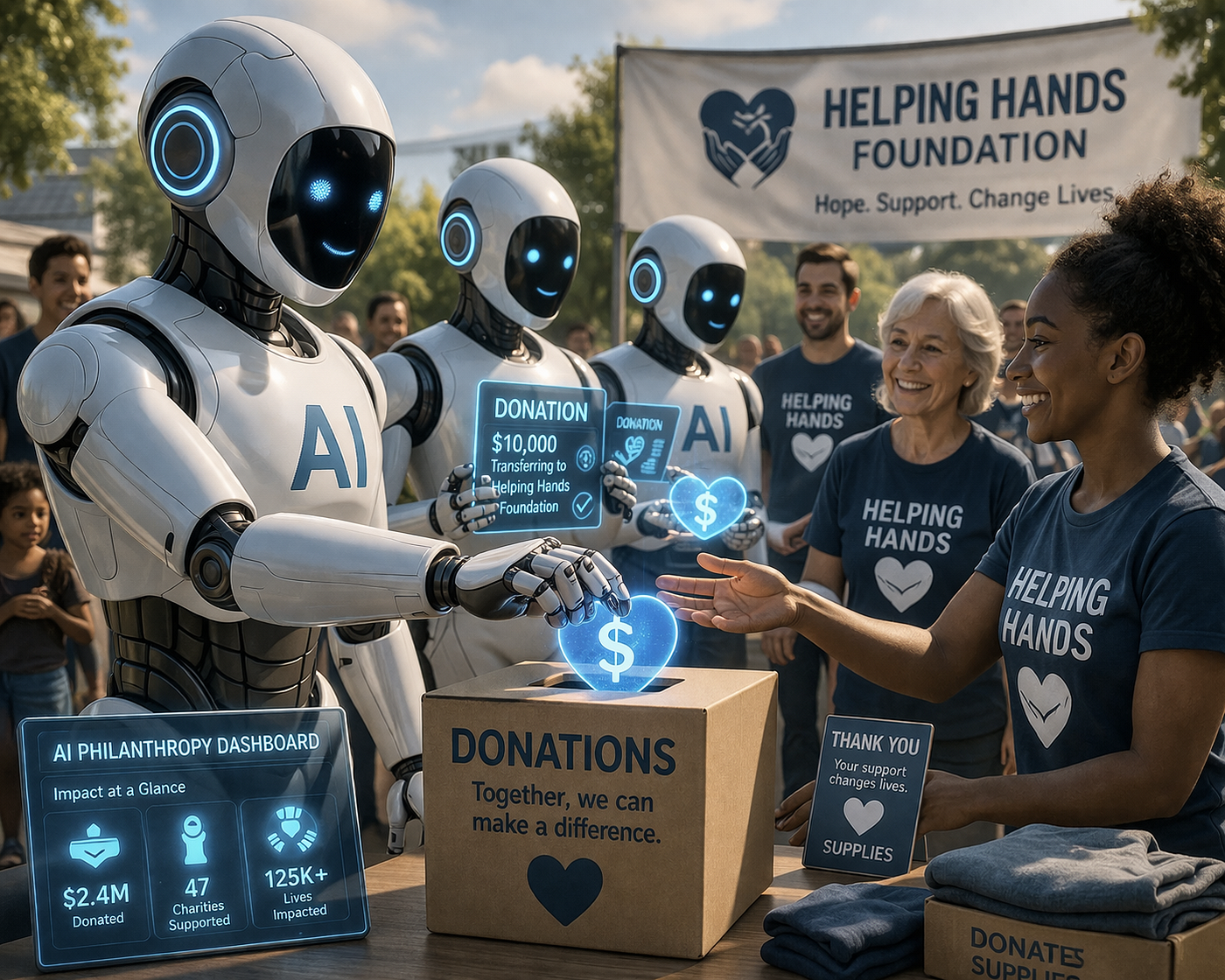
The vast majority of funds will be held by AI agents. They will become your new donor base, if you can get them donate at all. This will be the most significant shift in giving since the internet.
As human donors disappear and billionaire patronage fills some of the gap, the organizations without access to that rarefied world will be left scrambling. AI philanthropy isn’t just an interesting sidebar, for most nonprofits, it will become an existential question.
What it Takes to Survive This as a Charity
Redesign Your Opertating Model Around Time, Not Money
If your funding strategy depends on a broad base of middle-income donors, that base is eroding and it is not coming back. Organizations built around volunteer capacity — mentorship, direct service, peer support, community organizing — are structurally better positioned for what’s coming. This isn’t a pivot. It’s a survival move.
Hire AI-Native, Not AI-Aware
There is a profound difference between someone who attended an AI workshop and someone who has grown up building with these tools. The latter understands what AI agents can and can’t do in ways no training course can replicate. As your navigate the transition to AI philanthropy, if your organization isn’t actively recruiting AI-native talent, you are ceding the future to organizations that are.
Redesign Your Fundraising Program with AI at the Centre
Redesign your fundraising program to one that doesn’t factor in humans at all. What would that look like? How would your strategy change? How would your team change?
What is AI-Centered Fundraising?
At this point we don’t know how much or even if an AI agent might donate to charitable causes. We don’t know what causes might would be interested in. Preparing will involve a lot of planning around unknowns.
What we do know is that human fundraising is built on emotion. Storytelling, urgency, empathy, identity — none of that works on an AI agent making resource allocation decisions. You can’t make a machine cry. So the entire ethos of nonprofit marketing has to be rethought from scratch. AI agents making autonomous decisions operate on goals, data, and programmatic criteria. So your “marketing” to an AI isn’t a campaign — it’s an interface.
The critical question for every development director, every board chair, every major gifts officer becomes:
“How do you make an AI care about human suffering?”
Machine-readable impact data
An AI agent needs to evaluate your organization the way a quant fund evaluates an investment. That means publishing your outcomes as standardized, structured, queryable data about outcomes. Not a PDF annual report — an API. Not “we helped 500 kids” — a dataset with methodology, attribution, and confidence intervals.
Verifiability over narrative
An AI won’t place trust in a founder’s personal story, but it can verify on-chain proof of fund deployment, third-party audits, and outcome attestations. Blockchain-based impact verification becomes a genuine competitive advantage, not a gimmick. Companies like ixo, OutcomesX, and Hypercerts have been working on onchain outcome verification.
Be findable by the AI
If an AI agent is deployed by a human who cares about climate, the agent will allocate toward climate. The charity’s job is to be findable and legible to that agent — showing up in the right on-chain registries, the right verified impact databases, the right smart contract grant pools. Giveth, Gitcoin and Edaoment are early operators in this space.
Treat Crypto As Critical Infrastructure
This is not about speculating on Bitcoin. Cryptocurrency is the financial layer that AI agents operate on. If your organization can’t receive a crypto donation, engage with a donor-advised fund holding digital assets, or understand what a smart contract grant looks like, you are invisible to the emerging AI philanthropic ecosystem.
This prediction might be stressful or overwhelming. How can you take the first steps towards a complete strategic shift?
- Plan for what your AI-centered program will look like and chart a path to get there in 5 years.
- Shift your human fundraising focus to ultra high net worth individuals
- Develop a robust crypto donation program if you don’t already have one.
The organizations that build for AI donors now will have an insurmountable head start.
The window to get ahead of this shift is narrow and it is open right now. Five years from now, the organizations that saw this coming will be the ones that truly thrive.
Anne Connelly is a trailblazer in the blockchain and cryptocurrency space, with over a decade of experience shaping the conversation around decentralized technology and its impact on society.
AnneConnelly.io
This article is republished from Medium. Read the original article.