















Boston University Questrom School of Business’ Family Business@Questrom recently hosted its 3rd Annual Family Business Commencement Program — an afternoon dedicated to insight, inspiration, and connection, and a celebration of the growing Questrom family business community. The program was led by Patrick Abouchalache, Lecturer in Strategy and Innovation, Louis Salemy, Senior Lecturer of Finance, and Jay Zagorsky, Clinical Associate Professor of Markets, Public Policy, and Law. Following their remarks on “3 Big Ideas for Your Family Business,” attendees joined a networking reception with alumni, recent graduates, and their families, reflecting the strength and vibrancy of the global family business network at Questrom.
At the center of the discussion were three distinct perspectives from Questrom faculty and speakers, each offering a different lens on what the future of family business could look like. While the ideas ranged from communication and governance to AI and wealth management, together they highlighted how modern family businesses are being pushed to think more intentionally about continuity, adaptability, and long-term resilience.
Patrick Abouchalache’s Idea: “Plan Early, Speak Often” (PESO)
Patrick Abouchalache focused on one of the most common reasons family businesses fail: poor communication and weak governance. His core idea, “Plan Early, Speak Often” (PESO), emphasized the importance of having difficult conversations about succession, leadership transitions, family roles, and long-term goals before problems arise. Rather than waiting until moments of crisis, he argued that successful family businesses create regular, intentional communication habits across generations.
His perspective framed family businesses as ongoing, evolving systems that require structure, transparency, and storytelling to survive. Beyond internal operations, he also stressed the importance of families actively sharing their stories and values externally through thought leadership, branding, and community engagement.
Louis Salemy’s Idea: The Rise of the Family Office
Louis Salemy centered his discussion on the growing role of family offices as wealth transfers accelerate globally. His presentation explored how more families are creating professionalized structures to manage investing, estate planning, philanthropy, taxes, governance, and long-term financial strategy across generations.
He highlighted that family offices are no longer limited to ultra-wealthy dynasties but are increasingly becoming strategic tools for families seeking greater control, long-term continuity, and direct investment opportunities. Salemy also emphasized that planning early is critical, especially as an estimated $100 trillion in wealth is expected to transfer to younger generations over the next two decades. His perspective positioned wealth preservation and governance as equally important as wealth creation itself.
Jay Zagorsky’s Idea: AI Could Strengthen Family Businesses
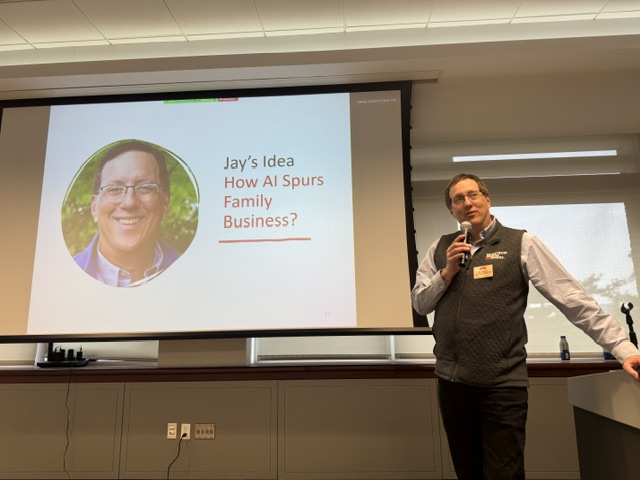
Jay Zagorsky offered perhaps the most unexpected argument of the event: AI may actually increase the number of family businesses rather than eliminate them. While many conversations around AI focus on automation and job loss, he argued that its long-term impact on family enterprises depends on how transformative the technology ultimately proves to be. He outlined two possible scenarios.
In the first scenario, AI is largely overhyped or incremental in its impact. In this case, family businesses would likely continue operating much as they do today, with no major structural changes driven by automation.
In the second scenario, where AI meaningfully reshapes the economy, the implications for family business could be significant. Zagorsky argued that AI could actually expand the number of family-run businesses by lowering barriers to entry, reducing the need for specialized labor, and enabling small teams to operate with far greater capability and efficiency. In this world, AI could make it easier to start, scale, and sustain family enterprises, while also increasing demand for more personal, trust-based business models.
He then outlined several reasons why family businesses could benefit in this second scenario:
- Family businesses often become more important during periods of economic uncertainty because they provide stability and trusted employment.
- AI tools can automate functions like marketing, finance, and operations, allowing smaller businesses to operate more efficiently with fewer resources.
- Consumers may increasingly gravitate toward family-run businesses because they offer more personal and human-centered experiences than large corporations.
At the same time, he warned that AI also creates risks, particularly around intellectual property theft, confidentiality, and resistance to technological change among older generations. His overall message was that the impact of AI on family business is not predetermined, it will depend on how deeply it reshapes work, markets, and trust.
Despite focusing on different aspects of family enterprise, all three speakers returned to a similar underlying idea: the future of family business will depend on intentionality. Whether that means planning earlier for succession, building structures to preserve wealth across generations, or adapting strategically to AI-driven disruption, family businesses can no longer rely solely on tradition or legacy to survive.
Instead, the discussion suggested that the next generation of successful family businesses will be those that balance long-term stewardship with a willingness to evolve. In an economy increasingly shaped by uncertainty, automation, and shifting workforce expectations, the very qualities that define many family businesses — trust, adaptability, personal connection, and long-term thinking — may ultimately become some of their greatest competitive advantages.
For further information on these topics contact Professor Abouchalache at pga4@bu.edu,
Professor Salemy at lsalemy@bu.edu, and Professor Zagorsky at zagorsky@bu.edu or connect with them on LinkedIn: Patrick Abouchalache, Louis Salemy, Jay Zagorsky.