

• About Us
  • Get Insights to Your Inbox
Tuesday, August 11, 2026
Generic selectors
Exact matches only
Search in title
Search in content
Post Type Selectors
Search in posts
Search in Author
Search Events
Filter by Categories
Action Learning
Artificial Intelligence in Business
Book Club
Books
BU Today
Business Challenges
Business Education
Business Functions
Business Policy & Markets
Corporate Strategy
Digital Business
Digital Business Institute
Diversity, Equity & Inclusion
Entrepreneurship & Innovation
Events
Expert Take
Feature
Finance & Accounting
Future of Business Education
Future of Work
Global Media
Harvard Business Review
Health, Biopharma, & Health-Tech
Human Resources Policy Institute
Innovation
Insights Live
Institute for Sustainable Energy
Journals
Language of Business
Leadership & Management
Local Media
Marketing
Media Mention
Multimedia
National Media
Newsletter Spotlight
Op-Ed
Operations
Opinion
Our Insights
Partners in Business Ethics
Podcast
Publications
Research Institutes
Risk
ScienceDirect
Silicon Valley Bank
Sloan Management Review
Social Impact
Special Series
Susilo Institute for Ethics in the Global Economy
Technology
The Brink
Thinkers50@BUQuestrom: Passion & Purpose
Videos
Insights@Questrom
  • Our Insights
    • All
    • Business Challenges
    • Business Education
    • Business Functions
    A Risk Management Nightmare at Silicon Valley Bank

    Your AI agent can be a teammate. But it still needs a boss 

    Best Personal Loans for a 600 Credit Score

    Bank of America® Travel Rewards credit card

    Newbury Street’s Sneaker Problem: Too Many Good Options? 

    Newbury Street’s Sneaker Problem: Too Many Good Options? 

    The Hidden Risk of Getting Paid in Stock Options 

    Is It OK to Eat the Same Things Every Day? 

    The New Layoff Playbook? Why Google and Microsoft Are Betting on Voluntary Exits  

    The New Layoff Playbook? Why Google and Microsoft Are Betting on Voluntary Exits  

    Push to roll back electric vehicle subsidies brings uncertainty for automakers 

    Should paper checks go the way of the penny? Americans still writing billions of them 

    Should paper checks be abolished like the penny?

    Should paper checks be abolished like the penny?

    America Has a School Attendance Crisis

    How Trump’s Drug Tariffs Could Hit Millions of Americans’ Medicine Bills

  • Videos & Podcast
    • All
    • Podcast
    • Videos
    S1:E1 CVS Paying the “Pink Tax” on Certain Products and the Evolution of the Electric Vehicle Industry

    How Leaders Turn Purpose Into Daily Behaviors

    Beyond Clicks and Sales: How Advertising Shapes Company Value in the Eyes of Investors

    S1:E1 CVS Paying the “Pink Tax” on Certain Products and the Evolution of the Electric Vehicle Industry

    Tariffs and Their Economic Impact

    S1:E1 CVS Paying the “Pink Tax” on Certain Products and the Evolution of the Electric Vehicle Industry

    Navigating Internet Privacy: Unpacking Cookies, Dark Patterns, and Future Data Protection Challenges (2)

    Beyond Prototypes: Rethinking Innovation in Complex Ecosystems with Prof. Douglas Hannah

    Beyond Prototypes: Rethinking Innovation in Complex Ecosystems with Prof. Douglas Hannah

    Is Business Broken? Season 2 out now! 

    Is Business Broken? Season 2 out now! 

    S1:E1 CVS Paying the “Pink Tax” on Certain Products and the Evolution of the Electric Vehicle Industry

    Redefining Retirement: Navigating Emotional and Social Transitions with Insightful Strategies

    Life After Cookies: Who Uses Google’s Privacy Sandbox? – Garrett Johnson

    Life After Cookies: Who Uses Google’s Privacy Sandbox? – Garrett Johnson

    S1:E1 CVS Paying the “Pink Tax” on Certain Products and the Evolution of the Electric Vehicle Industry

    Real Estate Ripples from a Landmark Settlement

  • Insights Events
    • Events
    • Insights Live
    • Questrom Institute Events
  • In the Media
    • All
    • BU Today
    • Global Media
    • Local Media
    • National Media
    • Op-Ed
    • The Brink
    A Risk Management Nightmare at Silicon Valley Bank

    Your AI agent can be a teammate. But it still needs a boss 

    Best Personal Loans for a 600 Credit Score

    Bank of America® Travel Rewards credit card

    Newbury Street’s Sneaker Problem: Too Many Good Options? 

    Newbury Street’s Sneaker Problem: Too Many Good Options? 

    The Hidden Risk of Getting Paid in Stock Options 

    Is It OK to Eat the Same Things Every Day? 

    The New Layoff Playbook? Why Google and Microsoft Are Betting on Voluntary Exits  

    The New Layoff Playbook? Why Google and Microsoft Are Betting on Voluntary Exits  

    Push to roll back electric vehicle subsidies brings uncertainty for automakers 

    Should paper checks go the way of the penny? Americans still writing billions of them 

    America Has a School Attendance Crisis

    How Trump’s Drug Tariffs Could Hit Millions of Americans’ Medicine Bills

    How Retailers Can Capitalize on the “Refund Effect”

    Frontline Workers Know How to Solve Your Organization’s Biggest Problems 

    A Risk Management Nightmare at Silicon Valley Bank

    Nvidia and Apple get a cut of every baby’s $1,000 Trump Account 

  • Publications
    • All
    • Books
    • Harvard Business Review
    • Journals
    • Sloan Management Review
    How Retailers Can Capitalize on the “Refund Effect”

    Frontline Workers Know How to Solve Your Organization’s Biggest Problems 

    How Retailers Can Capitalize on the “Refund Effect”

    Research: When Consumers Have More Control Over Ads, They Respond Better 

    How Retailers Can Capitalize on the “Refund Effect”

    Gen AI Could Fix Performance Reviews—or Make Them Even Worse 

    How Retailers Can Capitalize on the “Refund Effect”

    What Global Companies Lose When Decision-Making Revolves Around Headquarters 

    How Retailers Can Capitalize on the “Refund Effect”

    Research: Why You Shouldn’t Treat AI Agents Like Employees 

    How Retailers Can Capitalize on the “Refund Effect”

    Employees Are Relying on AI for Personal Support. That’s Risky. 

    How Retailers Can Capitalize on the “Refund Effect”

    Why Gen AI Feels So Threatening to Workers 

    How Retailers Can Capitalize on the “Refund Effect”

    Is Your Enterprise Data Strategy Ready for the Age of Intelligence? 

    How Retailers Can Capitalize on the “Refund Effect”

    Could the GPT Store Turn ChatGPT into a Platform Powerhouse? 

  • Questrom Book Club
Insights@Questrom
  • Our Insights
    • All
    • Business Challenges
    • Business Education
    • Business Functions
    A Risk Management Nightmare at Silicon Valley Bank

    Your AI agent can be a teammate. But it still needs a boss 

    Best Personal Loans for a 600 Credit Score

    Bank of America® Travel Rewards credit card

    Newbury Street’s Sneaker Problem: Too Many Good Options? 

    Newbury Street’s Sneaker Problem: Too Many Good Options? 

    The Hidden Risk of Getting Paid in Stock Options 

    Is It OK to Eat the Same Things Every Day? 

    The New Layoff Playbook? Why Google and Microsoft Are Betting on Voluntary Exits  

    The New Layoff Playbook? Why Google and Microsoft Are Betting on Voluntary Exits  

    Push to roll back electric vehicle subsidies brings uncertainty for automakers 

    Should paper checks go the way of the penny? Americans still writing billions of them 

    Should paper checks be abolished like the penny?

    Should paper checks be abolished like the penny?

    America Has a School Attendance Crisis

    How Trump’s Drug Tariffs Could Hit Millions of Americans’ Medicine Bills

  • Videos & Podcast
    • All
    • Podcast
    • Videos
    S1:E1 CVS Paying the “Pink Tax” on Certain Products and the Evolution of the Electric Vehicle Industry

    How Leaders Turn Purpose Into Daily Behaviors

    Beyond Clicks and Sales: How Advertising Shapes Company Value in the Eyes of Investors

    S1:E1 CVS Paying the “Pink Tax” on Certain Products and the Evolution of the Electric Vehicle Industry

    Tariffs and Their Economic Impact

    S1:E1 CVS Paying the “Pink Tax” on Certain Products and the Evolution of the Electric Vehicle Industry

    Navigating Internet Privacy: Unpacking Cookies, Dark Patterns, and Future Data Protection Challenges (2)

    Beyond Prototypes: Rethinking Innovation in Complex Ecosystems with Prof. Douglas Hannah

    Beyond Prototypes: Rethinking Innovation in Complex Ecosystems with Prof. Douglas Hannah

    Is Business Broken? Season 2 out now! 

    Is Business Broken? Season 2 out now! 

    S1:E1 CVS Paying the “Pink Tax” on Certain Products and the Evolution of the Electric Vehicle Industry

    Redefining Retirement: Navigating Emotional and Social Transitions with Insightful Strategies

    Life After Cookies: Who Uses Google’s Privacy Sandbox? – Garrett Johnson

    Life After Cookies: Who Uses Google’s Privacy Sandbox? – Garrett Johnson

    S1:E1 CVS Paying the “Pink Tax” on Certain Products and the Evolution of the Electric Vehicle Industry

    Real Estate Ripples from a Landmark Settlement

  • Insights Events
    • Events
    • Insights Live
    • Questrom Institute Events
  • In the Media
    • All
    • BU Today
    • Global Media
    • Local Media
    • National Media
    • Op-Ed
    • The Brink
    A Risk Management Nightmare at Silicon Valley Bank

    Your AI agent can be a teammate. But it still needs a boss 

    Best Personal Loans for a 600 Credit Score

    Bank of America® Travel Rewards credit card

    Newbury Street’s Sneaker Problem: Too Many Good Options? 

    Newbury Street’s Sneaker Problem: Too Many Good Options? 

    The Hidden Risk of Getting Paid in Stock Options 

    Is It OK to Eat the Same Things Every Day? 

    The New Layoff Playbook? Why Google and Microsoft Are Betting on Voluntary Exits  

    The New Layoff Playbook? Why Google and Microsoft Are Betting on Voluntary Exits  

    Push to roll back electric vehicle subsidies brings uncertainty for automakers 

    Should paper checks go the way of the penny? Americans still writing billions of them 

    America Has a School Attendance Crisis

    How Trump’s Drug Tariffs Could Hit Millions of Americans’ Medicine Bills

    How Retailers Can Capitalize on the “Refund Effect”

    Frontline Workers Know How to Solve Your Organization’s Biggest Problems 

    A Risk Management Nightmare at Silicon Valley Bank

    Nvidia and Apple get a cut of every baby’s $1,000 Trump Account 

  • Publications
    • All
    • Books
    • Harvard Business Review
    • Journals
    • Sloan Management Review
    How Retailers Can Capitalize on the “Refund Effect”

    Frontline Workers Know How to Solve Your Organization’s Biggest Problems 

    How Retailers Can Capitalize on the “Refund Effect”

    Research: When Consumers Have More Control Over Ads, They Respond Better 

    How Retailers Can Capitalize on the “Refund Effect”

    Gen AI Could Fix Performance Reviews—or Make Them Even Worse 

    How Retailers Can Capitalize on the “Refund Effect”

    What Global Companies Lose When Decision-Making Revolves Around Headquarters 

    How Retailers Can Capitalize on the “Refund Effect”

    Research: Why You Shouldn’t Treat AI Agents Like Employees 

    How Retailers Can Capitalize on the “Refund Effect”

    Employees Are Relying on AI for Personal Support. That’s Risky. 

    How Retailers Can Capitalize on the “Refund Effect”

    Why Gen AI Feels So Threatening to Workers 

    How Retailers Can Capitalize on the “Refund Effect”

    Is Your Enterprise Data Strategy Ready for the Age of Intelligence? 

    How Retailers Can Capitalize on the “Refund Effect”

    Could the GPT Store Turn ChatGPT into a Platform Powerhouse? 

  • Questrom Book Club
Insights@Questrom
Home Our Insights Business Functions

Should paper checks be abolished like the penny?

The Conversation

Jay ZagorskyfeaturingJay Zagorsky
July 24, 2026 - Updated On August 6, 2026
in Business Functions, Business Policy & Markets, Finance & Accounting, Our Insights
18
0
Should paper checks be abolished like the penny?
Share on FacebookShare on TwitterShare on LinkedIn

While Americans are writing fewer checks, they haven’t abandoned this means of payment.

Germany is getting rid of paper checks at the end of 2027. Australia is bidding them farewell by 2030. U.S. President Donald Trump followed up his order killing off the penny with an executive order stopping check writing by the federal government.

Should the U.S. follow these other countries and broadly eliminate the ability to write checks?

Years ago, experts predicted that checks would have disappeared by now. However, they are still around, and billions are written each year in the United States.

Why? The quick answer is that businesses love them. And plenty of Americans still use checks for good reasons. But there is more to the story.

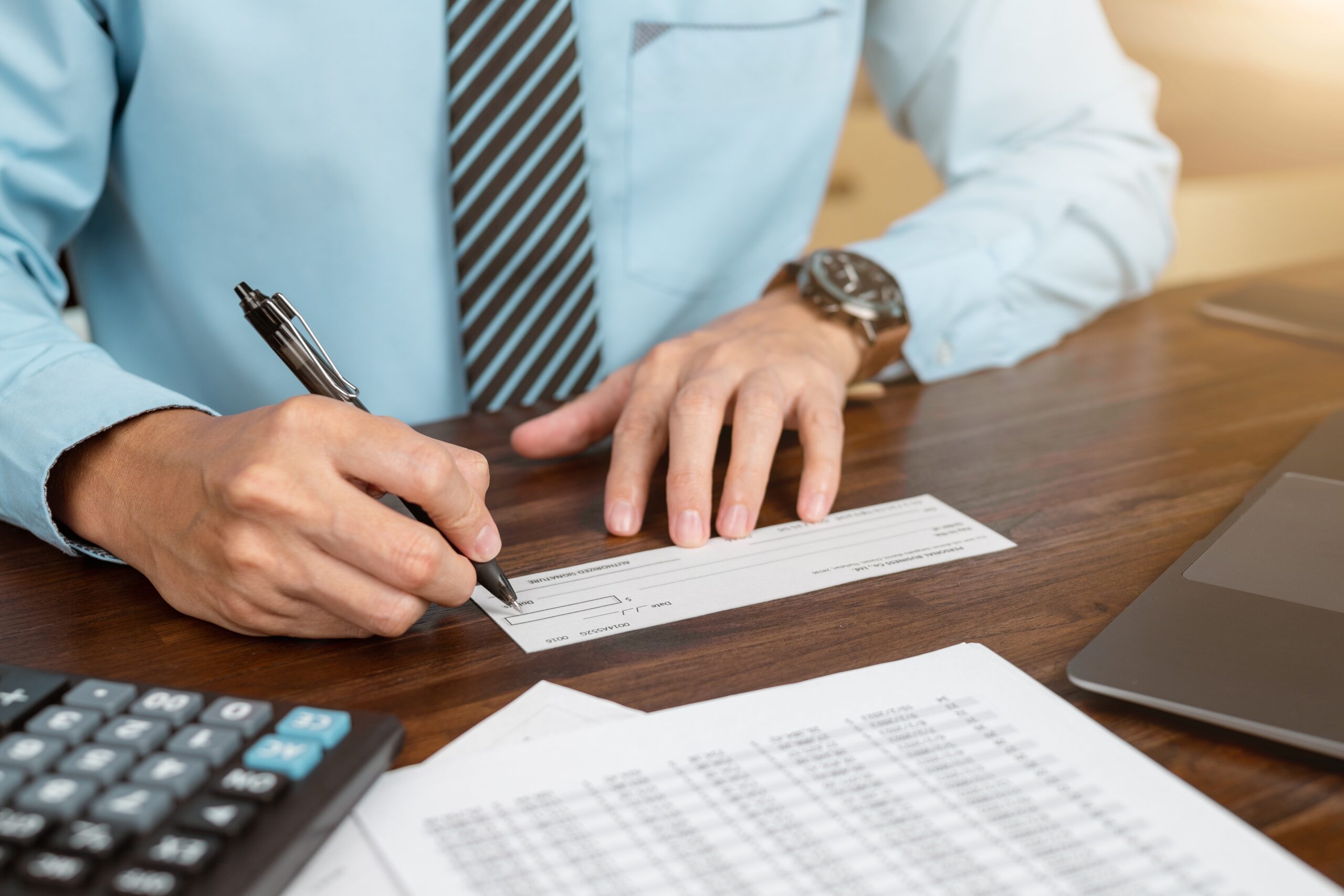
I am a business school professor and one of the few academics who advocates for the use of cash. While I have long told everyone about the benefits of paper money, I didn’t give paper checks much thought or use them until my mother’s recent death. Then I found myself writing checks to the cemetery, funeral home, gravestone engraver and a host of other places. Plus, I started getting refund checks back from her landlord and insurance companies.

These experiences made me look more deeply into this form of payment to understand what was happening.

Fewer checks for bigger bucks

Every three years the U.S. government runs the Federal Reserve Payments Study by asking banks and credit unions for internal information. This survey tracks everything from how often credit cards are used to the number of checks written.

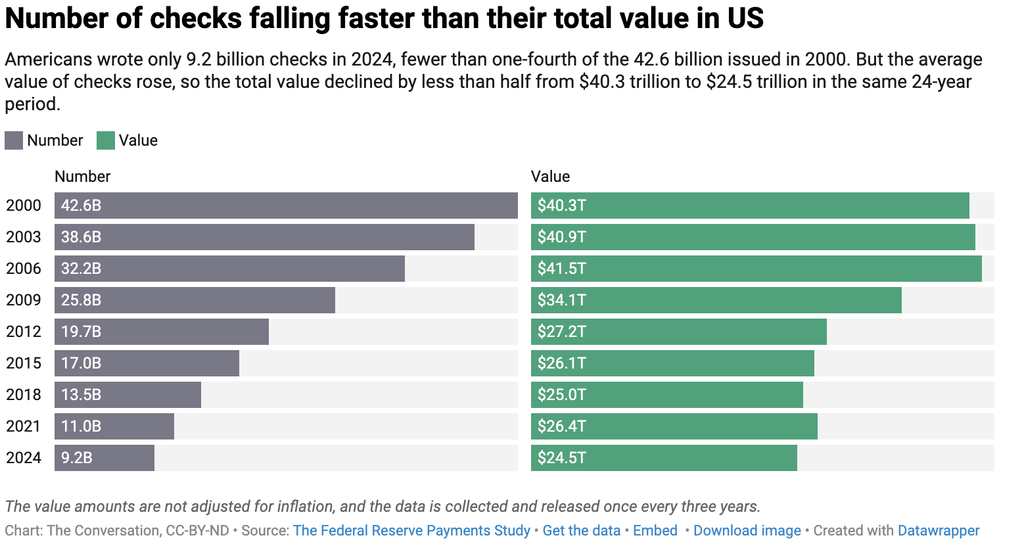
While check usage has sharply declined in the U.S., a significant number – about 9.2 billion in 2024 – are still written, the data shows. The face value of those checks is probably bigger than you’d expect: more than US$24 trillion, not adjusted for inflation. That is almost as large as U.S. gross domestic product of $29 trillion that year.

Not everyone can imagine numbers in billions or trillions, so let’s put those figures in more manageable terms.

A little over 150 checks were written per person in 2000. By 2024, the average had plummeted to 27 checks – slightly more than two per month. However, over that time, the amounts typically scribbled or printed on the face of those checks rose.

In 2000, the typical check was worth less than $1,000. By 2024, the average amount had more than doubled to $2,600.

Trends elsewhere are similar. The Bank for International Settlements, which serves as a bank for central banks like the Federal Reserve, has tracked check usage in 25 countries since 2012. Its data shows that in only two other countries is payment by check still commonplace.

And in both of those countries, check usage has fallen more sharply than in the United States.
Who uses checks today?

While check payments have declined, there are still two big groups of check writers in the United States.

The Federal Reserve Bank of Atlanta runs the Survey and Diary of Consumer Payment Choice. This survey asks people, rather than banks, for information on their payment habits. Roughly one-third of all respondents stated they used a paper check in the past 30 days.

An older lady writes out checks to pay bills.
Older Americans write more checks than younger people. Jupiterimages/The Image Bank via Getty Images

Not surprisingly, the answers vary by age. About 60% of people 65 and over say they wrote a check. Among those 18 to 24, under 6% said they did.

It also turns out that a lot of people who think they never write checks actually unknowingly do it all the time. If you pay your bills online, your bank tries to pay them electronically. If it cannot electronically make the payment, the bank cuts a paper check on your behalf. Any online bill payment taking more than a couple of business days to post is being sent by check.

Another important factor is that small businesses love checks. Over 80% of businesses with sales between $1 and $10 million make payments using checks. Why? Small businesses often require two signatures on a check. The need for signatures means owners have to sign their name before any money goes out the door. This gives them control over money and a clear idea who is getting paid and how much.

Small businesses also like receiving checks. I wrote a lot of checks after my mother’s death because many of those small businesses I dealt with wanted an extra 3% and sometimes more to cover the cost to them of a credit card payment. Writing paper checks saved me and the businesses a lot of money.

The future

While many Americans still write checks, their declining usage clearly underscores that they are not ideal for making payments in all situations.

One of the biggest problems with checks is that you never know if the check writer has sufficient funds to cover the amount. When an account doesn’t have enough money, the check bounces. The Federal Reserve, which clears about one-third of all U.S. checks, returned about 22 million checks, with a total face value of around $80 billion. While these numbers are large, over 99% of all checks written don’t bounce.

Another problem with checks is forgery. Thieves steal checks from mailboxes, alter information and then cash them. The most recent figures show about 500,000 annual cases of check fraud in the U.S. Again, while a half-million is large, it is a tiny fraction of the 9.2 billion checks written annually.

Because of these problems, the Federal Reserve is contemplating leaving the check processing business. In early 2026, it accepted public comments on whether it should wind down, improve or leave alone its check processing unit.

The unit, which costs about $100 million a year to run, turned a $6.6 million profit in 2024. But its machines need replacing, and the Federal Reserve is wavering on spending the money.

Front and back of a U.S. half-cent coin.
The U.S. government stopped minting its half-cent coin in 1857 due to its lack of usefulness. Mark Kostich/iStock via Getty Images Plus

Should checks be killed off like the penny, which the federal government stopped minting in 2025, and the haypenny, which was worth half a cent and hasn’t been produced since 1857?

For me, the answer is a clear no. While checks are clearly less important today than in the past, the numbers show that the American people and businesses still use and need checks.

This article is republished from The Conversation under a Creative Commons license. Read the original article.
Source: Should paper checks be abolished like the penny?
Via: The Conversation
Tags: BankingCashless SocietyJay ZagorskyPaper ChecksPaymentsThe Conversation
Jay Zagorsky

Jay Zagorsky

Jay Zagorsky is Clinical Associate Professor in Markets, Public Policy, & Law and is a cross-disciplinary researcher who has spent over two decades of researching a wide variety of personal wealth topics. He tries to explain why some people become rich, others are poor and some move between these two states. He is currently synthesizing this research into a book that presents the results of his academic research and other wealth researchers in an accessible format.

Related Insights

The New Layoff Playbook? Why Google and Microsoft Are Betting on Voluntary Exits  
Business Challenges

The New Layoff Playbook? Why Google and Microsoft Are Betting on Voluntary Exits  

July 27, 2026 - Updated On August 5, 2026
Push to roll back electric vehicle subsidies brings uncertainty for automakers 
Business Functions

Should paper checks go the way of the penny? Americans still writing billions of them 

July 27, 2026 - Updated On August 5, 2026
A Risk Management Nightmare at Silicon Valley Bank
Business Policy & Markets

Nvidia and Apple get a cut of every baby’s $1,000 Trump Account 

July 19, 2026 - Updated On July 23, 2026
Best Personal Loans for a 600 Credit Score
Media Mention

Best Business Credit Cards for New Businesses

June 4, 2026
Rethinking Family Business: Three Big Ideas from Questrom  
Business Functions

Rethinking Family Business: Three Big Ideas from Questrom  

June 3, 2026
Wendy’s plans to roll out dynamic pricing
Business Policy & Markets

Clover to close all its vegetarian restaurants around Boston: “Everyone is getting hit with rising costs” 

May 27, 2026 - Updated On June 10, 2026

Upcoming Events

No event found!

Get Our Insights Newsletter

Get Insights straight to your inbox by signing up now.

    Popular Insights

    • Questrom to Host City of Boston’s Civic Summit 2026

      Questrom to Host City of Boston’s Civic Summit 2026

      11 shares
      Share 4 Tweet 3
    • Newbury Street’s Sneaker Problem: Too Many Good Options? 

      8 shares
      Share 3 Tweet 2
    • Why this year’s World Cup is so pricey 

      7 shares
      Share 3 Tweet 2
    • We’re Only Starting to Grasp the Pitfalls of Using A.I. at Work 

      6 shares
      Share 2 Tweet 2
    • High costs push more Americans to rent instead of buy 

      7 shares
      Share 3 Tweet 2

    Boston University Questrom School of Business
    595 Commonwealth Avenue
    Boston, MA 02215

    Follow Us

    Newsletter

    © 2023 Trustees of Boston University

    • About Us
    • Digital Business Institute
    • Human Resource Policy Institute
    • Susilo Institute for Ethics in the Global Economy

    Welcome Back!

    Sign In with Linked In
    OR

    Login to your account below

    Forgotten Password?

    Retrieve your password

    Please enter your username or email address to reset your password.

    Log In

    Add New Playlist

    Generic selectors
    Exact matches only
    Search in title
    Search in content
    Post Type Selectors
    Search in posts
    Search in Author
    Search Events
    Filter by Categories
    Action Learning
    Artificial Intelligence in Business
    Book Club
    Books
    BU Today
    Business Challenges
    Business Education
    Business Functions
    Business Policy & Markets
    Corporate Strategy
    Digital Business
    Digital Business Institute
    Diversity, Equity & Inclusion
    Entrepreneurship & Innovation
    Events
    Expert Take
    Feature
    Finance & Accounting
    Future of Business Education
    Future of Work
    Global Media
    Harvard Business Review
    Health, Biopharma, & Health-Tech
    Human Resources Policy Institute
    Innovation
    Insights Live
    Institute for Sustainable Energy
    Journals
    Language of Business
    Leadership & Management
    Local Media
    Marketing
    Media Mention
    Multimedia
    National Media
    Newsletter Spotlight
    Op-Ed
    Operations
    Opinion
    Our Insights
    Partners in Business Ethics
    Podcast
    Publications
    Research Institutes
    Risk
    ScienceDirect
    Silicon Valley Bank
    Sloan Management Review
    Social Impact
    Special Series
    Susilo Institute for Ethics in the Global Economy
    Technology
    The Brink
    Thinkers50@BUQuestrom: Passion & Purpose
    Videos
    • Business Challenges
      • Business Policy & Markets
      • Digital Business
      • Diversity, Equity & Inclusion
      • Entrepreneurship & Innovation
      • Future of Work
      • Health, Biopharma, & Health-Tech
      • Risk
      • Social Impact
    • Business Functions
      • Corporate Strategy
      • Finance & Accounting
      • Innovation
      • Leadership & Management
      • Marketing
      • Operations
      • Technology
    • Publications
      • Journals
      • Harvard Business Review
      • Sloan Management Review
    • Insights Events
      • All Events
      • Insights Live
      • Questrom Institute Events
    • Videos & Podcast
      • Videos
      • Insights@Questrom Podcast
      • Podcast
    • Voices in the Media
    • Our Experts

    © 2023 Trustees of Boston University

    -
    00:00
    00:00

    Queue

    Update Required Flash plugin
    -
    00:00
    00:00