




• About Us
  • Get Insights to Your Inbox
Sunday, August 16, 2026
Generic selectors
Exact matches only
Search in title
Search in content
Post Type Selectors
Search in posts
Search in Author
Search Events
Filter by Categories
Action Learning
Artificial Intelligence in Business
Book Club
Books
BU Today
Business Challenges
Business Education
Business Functions
Business Policy & Markets
Corporate Strategy
Digital Business
Digital Business Institute
Diversity, Equity & Inclusion
Entrepreneurship & Innovation
Events
Expert Take
Feature
Finance & Accounting
Future of Business Education
Future of Work
Global Media
Harvard Business Review
Health, Biopharma, & Health-Tech
Human Resources Policy Institute
Innovation
Insights Live
Institute for Sustainable Energy
Journals
Language of Business
Leadership & Management
Local Media
Marketing
Media Mention
Multimedia
National Media
Newsletter Spotlight
Op-Ed
Operations
Opinion
Our Insights
Partners in Business Ethics
Podcast
Publications
Research Institutes
Risk
ScienceDirect
Silicon Valley Bank
Sloan Management Review
Social Impact
Special Series
Susilo Institute for Ethics in the Global Economy
Technology
The Brink
Thinkers50@BUQuestrom: Passion & Purpose
Videos
Insights@Questrom
  • Our Insights
    • All
    • Business Challenges
    • Business Education
    • Business Functions
    Shareholders Are People, Too

    An Early Bet on SpaceX Led to a 30% Gain for This College Endowment

    A Risk Management Nightmare at Silicon Valley Bank

    Your AI agent can be a teammate. But it still needs a boss 

    Best Personal Loans for a 600 Credit Score

    Bank of America® Travel Rewards credit card

    Newbury Street’s Sneaker Problem: Too Many Good Options? 

    Newbury Street’s Sneaker Problem: Too Many Good Options? 

    The Hidden Risk of Getting Paid in Stock Options 

    Is It OK to Eat the Same Things Every Day? 

    The New Layoff Playbook? Why Google and Microsoft Are Betting on Voluntary Exits  

    The New Layoff Playbook? Why Google and Microsoft Are Betting on Voluntary Exits  

    Push to roll back electric vehicle subsidies brings uncertainty for automakers 

    Should paper checks go the way of the penny? Americans still writing billions of them 

    Should paper checks be abolished like the penny?

    Should paper checks be abolished like the penny?

  • Videos & Podcast
    • All
    • Podcast
    • Videos
    S1:E1 CVS Paying the “Pink Tax” on Certain Products and the Evolution of the Electric Vehicle Industry

    How Leaders Turn Purpose Into Daily Behaviors

    Beyond Clicks and Sales: How Advertising Shapes Company Value in the Eyes of Investors

    S1:E1 CVS Paying the “Pink Tax” on Certain Products and the Evolution of the Electric Vehicle Industry

    Tariffs and Their Economic Impact

    S1:E1 CVS Paying the “Pink Tax” on Certain Products and the Evolution of the Electric Vehicle Industry

    Navigating Internet Privacy: Unpacking Cookies, Dark Patterns, and Future Data Protection Challenges (2)

    Beyond Prototypes: Rethinking Innovation in Complex Ecosystems with Prof. Douglas Hannah

    Beyond Prototypes: Rethinking Innovation in Complex Ecosystems with Prof. Douglas Hannah

    Is Business Broken? Season 2 out now! 

    Is Business Broken? Season 2 out now! 

    S1:E1 CVS Paying the “Pink Tax” on Certain Products and the Evolution of the Electric Vehicle Industry

    Redefining Retirement: Navigating Emotional and Social Transitions with Insightful Strategies

    Life After Cookies: Who Uses Google’s Privacy Sandbox? – Garrett Johnson

    Life After Cookies: Who Uses Google’s Privacy Sandbox? – Garrett Johnson

    S1:E1 CVS Paying the “Pink Tax” on Certain Products and the Evolution of the Electric Vehicle Industry

    Real Estate Ripples from a Landmark Settlement

  • Insights Events
    • Events
    • Insights Live
    • Questrom Institute Events
  • In the Media
    • All
    • BU Today
    • Global Media
    • Local Media
    • National Media
    • Op-Ed
    • The Brink
    Shareholders Are People, Too

    An Early Bet on SpaceX Led to a 30% Gain for This College Endowment

    A Risk Management Nightmare at Silicon Valley Bank

    Your AI agent can be a teammate. But it still needs a boss 

    Best Personal Loans for a 600 Credit Score

    Bank of America® Travel Rewards credit card

    Newbury Street’s Sneaker Problem: Too Many Good Options? 

    Newbury Street’s Sneaker Problem: Too Many Good Options? 

    The Hidden Risk of Getting Paid in Stock Options 

    Is It OK to Eat the Same Things Every Day? 

    The New Layoff Playbook? Why Google and Microsoft Are Betting on Voluntary Exits  

    The New Layoff Playbook? Why Google and Microsoft Are Betting on Voluntary Exits  

    Push to roll back electric vehicle subsidies brings uncertainty for automakers 

    Should paper checks go the way of the penny? Americans still writing billions of them 

    Rollover Risk, Not Maturity, Decides Which Deals Happen

    Rollover Risk, Not Maturity, Decides Which Deals Happen

    America Has a School Attendance Crisis

    How Trump’s Drug Tariffs Could Hit Millions of Americans’ Medicine Bills

  • Publications
    • All
    • Books
    • Harvard Business Review
    • Journals
    • Sloan Management Review
    How Retailers Can Capitalize on the “Refund Effect”

    Frontline Workers Know How to Solve Your Organization’s Biggest Problems 

    How Retailers Can Capitalize on the “Refund Effect”

    Research: When Consumers Have More Control Over Ads, They Respond Better 

    How Retailers Can Capitalize on the “Refund Effect”

    Gen AI Could Fix Performance Reviews—or Make Them Even Worse 

    How Retailers Can Capitalize on the “Refund Effect”

    What Global Companies Lose When Decision-Making Revolves Around Headquarters 

    How Retailers Can Capitalize on the “Refund Effect”

    Research: Why You Shouldn’t Treat AI Agents Like Employees 

    How Retailers Can Capitalize on the “Refund Effect”

    Employees Are Relying on AI for Personal Support. That’s Risky. 

    How Retailers Can Capitalize on the “Refund Effect”

    Why Gen AI Feels So Threatening to Workers 

    How Retailers Can Capitalize on the “Refund Effect”

    Is Your Enterprise Data Strategy Ready for the Age of Intelligence? 

    How Retailers Can Capitalize on the “Refund Effect”

    Could the GPT Store Turn ChatGPT into a Platform Powerhouse? 

  • Questrom Book Club
Insights@Questrom
  • Our Insights
    • All
    • Business Challenges
    • Business Education
    • Business Functions
    Shareholders Are People, Too

    An Early Bet on SpaceX Led to a 30% Gain for This College Endowment

    A Risk Management Nightmare at Silicon Valley Bank

    Your AI agent can be a teammate. But it still needs a boss 

    Best Personal Loans for a 600 Credit Score

    Bank of America® Travel Rewards credit card

    Newbury Street’s Sneaker Problem: Too Many Good Options? 

    Newbury Street’s Sneaker Problem: Too Many Good Options? 

    The Hidden Risk of Getting Paid in Stock Options 

    Is It OK to Eat the Same Things Every Day? 

    The New Layoff Playbook? Why Google and Microsoft Are Betting on Voluntary Exits  

    The New Layoff Playbook? Why Google and Microsoft Are Betting on Voluntary Exits  

    Push to roll back electric vehicle subsidies brings uncertainty for automakers 

    Should paper checks go the way of the penny? Americans still writing billions of them 

    Should paper checks be abolished like the penny?

    Should paper checks be abolished like the penny?

  • Videos & Podcast
    • All
    • Podcast
    • Videos
    S1:E1 CVS Paying the “Pink Tax” on Certain Products and the Evolution of the Electric Vehicle Industry

    How Leaders Turn Purpose Into Daily Behaviors

    Beyond Clicks and Sales: How Advertising Shapes Company Value in the Eyes of Investors

    S1:E1 CVS Paying the “Pink Tax” on Certain Products and the Evolution of the Electric Vehicle Industry

    Tariffs and Their Economic Impact

    S1:E1 CVS Paying the “Pink Tax” on Certain Products and the Evolution of the Electric Vehicle Industry

    Navigating Internet Privacy: Unpacking Cookies, Dark Patterns, and Future Data Protection Challenges (2)

    Beyond Prototypes: Rethinking Innovation in Complex Ecosystems with Prof. Douglas Hannah

    Beyond Prototypes: Rethinking Innovation in Complex Ecosystems with Prof. Douglas Hannah

    Is Business Broken? Season 2 out now! 

    Is Business Broken? Season 2 out now! 

    S1:E1 CVS Paying the “Pink Tax” on Certain Products and the Evolution of the Electric Vehicle Industry

    Redefining Retirement: Navigating Emotional and Social Transitions with Insightful Strategies

    Life After Cookies: Who Uses Google’s Privacy Sandbox? – Garrett Johnson

    Life After Cookies: Who Uses Google’s Privacy Sandbox? – Garrett Johnson

    S1:E1 CVS Paying the “Pink Tax” on Certain Products and the Evolution of the Electric Vehicle Industry

    Real Estate Ripples from a Landmark Settlement

  • Insights Events
    • Events
    • Insights Live
    • Questrom Institute Events
  • In the Media
    • All
    • BU Today
    • Global Media
    • Local Media
    • National Media
    • Op-Ed
    • The Brink
    Shareholders Are People, Too

    An Early Bet on SpaceX Led to a 30% Gain for This College Endowment

    A Risk Management Nightmare at Silicon Valley Bank

    Your AI agent can be a teammate. But it still needs a boss 

    Best Personal Loans for a 600 Credit Score

    Bank of America® Travel Rewards credit card

    Newbury Street’s Sneaker Problem: Too Many Good Options? 

    Newbury Street’s Sneaker Problem: Too Many Good Options? 

    The Hidden Risk of Getting Paid in Stock Options 

    Is It OK to Eat the Same Things Every Day? 

    The New Layoff Playbook? Why Google and Microsoft Are Betting on Voluntary Exits  

    The New Layoff Playbook? Why Google and Microsoft Are Betting on Voluntary Exits  

    Push to roll back electric vehicle subsidies brings uncertainty for automakers 

    Should paper checks go the way of the penny? Americans still writing billions of them 

    Rollover Risk, Not Maturity, Decides Which Deals Happen

    Rollover Risk, Not Maturity, Decides Which Deals Happen

    America Has a School Attendance Crisis

    How Trump’s Drug Tariffs Could Hit Millions of Americans’ Medicine Bills

  • Publications
    • All
    • Books
    • Harvard Business Review
    • Journals
    • Sloan Management Review
    How Retailers Can Capitalize on the “Refund Effect”

    Frontline Workers Know How to Solve Your Organization’s Biggest Problems 

    How Retailers Can Capitalize on the “Refund Effect”

    Research: When Consumers Have More Control Over Ads, They Respond Better 

    How Retailers Can Capitalize on the “Refund Effect”

    Gen AI Could Fix Performance Reviews—or Make Them Even Worse 

    How Retailers Can Capitalize on the “Refund Effect”

    What Global Companies Lose When Decision-Making Revolves Around Headquarters 

    How Retailers Can Capitalize on the “Refund Effect”

    Research: Why You Shouldn’t Treat AI Agents Like Employees 

    How Retailers Can Capitalize on the “Refund Effect”

    Employees Are Relying on AI for Personal Support. That’s Risky. 

    How Retailers Can Capitalize on the “Refund Effect”

    Why Gen AI Feels So Threatening to Workers 

    How Retailers Can Capitalize on the “Refund Effect”

    Is Your Enterprise Data Strategy Ready for the Age of Intelligence? 

    How Retailers Can Capitalize on the “Refund Effect”

    Could the GPT Store Turn ChatGPT into a Platform Powerhouse? 

  • Questrom Book Club
Insights@Questrom
Home Our Insights Business Education

Have we forgotten the true meaning of Labor Day?

Jay ZagorskyfeaturingJay Zagorsky
September 15, 2022
in Business Education, Business Functions
50
0
Have we forgotten the true meaning of Labor Day?
Share on FacebookShare on TwitterShare on LinkedIn

Labor Day is a U.S. national holiday held the first Monday every September. Unlike most U.S. holidays, it is a strange celebration without rituals, except for shopping and barbecuing. For most people it simply marks the last weekend of summer and the start of the school year.

The holiday’s founders in the late 1800s envisioned something very different from what the day has become. The founders were looking for two things: a means of unifying union workers and a reduction in work time.

History of Labor Day

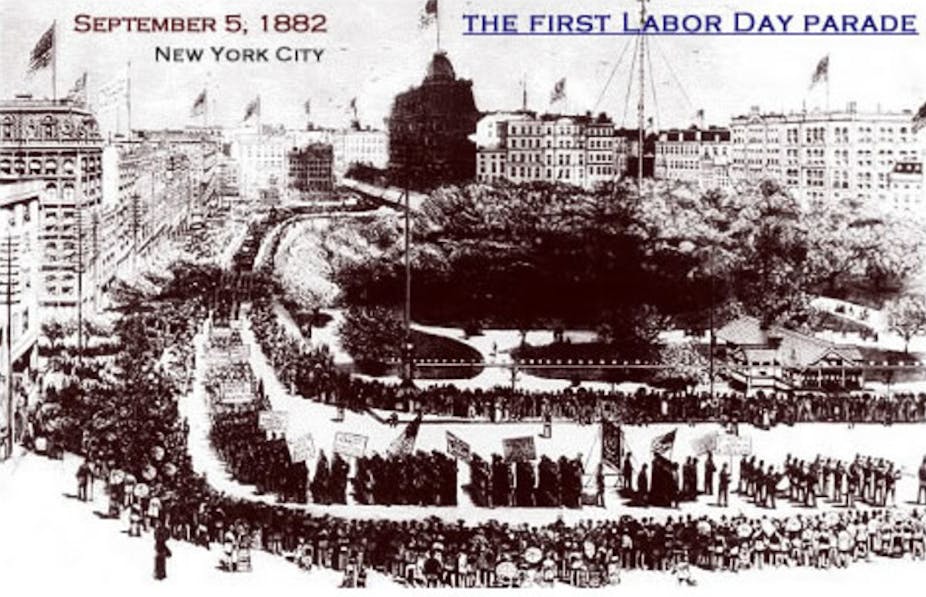
The first Labor Day occurred in 1882 in New York City under the direction of that city’s Central Labor Union.

In the 1800s, unions covered only a small fraction of workers and were balkanized and relatively weak. The goal of organizations like the Central Labor Union and more modern-day counterparts like the AFL-CIO was to bring many small unions together to achieve a critical mass and power. The organizers of the first Labor Day were interested in creating an event that brought different types of workers together to meet each other and recognize their common interests.

However, the organizers had a large problem: No government or company recognized the first Monday in September as a day off work. The issue was solved temporarily by declaring a one-day strike in the city. All striking workers were expected to march in a parade and then eat and drink at a giant picnic afterwards.

The New York Tribune’s reporter covering the event felt the entire day was like one long political barbecue, with “rather dull speeches.”

Why was Labor Day invented?

Labor Day came about because workers felt they were spending too many hours and days on the job.

In the 1830s, manufacturing workers were putting in 70-hour weeks on average. Sixty years later, in 1890, hours of work had dropped, although the average manufacturing worker still toiled in a factory 60 hours a week.

These long working hours caused many union organizers to focus on winning a shorter eight-hour work day. They also focused on getting workers more days off, such as the Labor Day holiday, and reducing the workweek to just six days.

These early organizers clearly won since the most recent data show that the average person working in manufacturing is employed for a bit over 40 hours a week and most people work only five days a week.

Surprisingly, many politicians and business owners were actually in favor of giving workers more time off. That’s because workers who had no free time were not able to spend their wages on traveling, entertainment or dining out.

As the U.S. economy expanded beyond farming and basic manufacturing in the late 1800s and early 1900s, it became important for businesses to find consumers interested in buying the products and services being produced in ever greater amounts. Shortening the work week was one way of turning the working class into the consuming class.

Common misconceptions

The common misconception is that since Labor Day is a national holiday, everyone gets the day off. Nothing could be further from the truth.

While the first Labor Day was created by striking, the idea of a special holiday for workers was easy for politicians to support. It was easy because proclaiming a holiday, like Mother’s Day, costs legislators nothing and benefits them by currying favor with voters. In 1887, Oregon, Colorado, Massachusetts, New York and New Jersey all declared a special legal holiday in September to celebrate workers.

Within 12 years, half the states in the country recognized Labor Day as a holiday. It became a national holiday in June 1894 when President Grover Cleveland signed the Labor Day bill into law. While most people interpreted this as recognizing the day as a national vacation, Congress’ proclamation covers only federal employees. It is up to each state to declare its own legal holidays.

Moreover, proclaiming any day an official holiday means little, as an official holiday does not require private employers and even some government agencies to give their workers the day off. Many stores are open on Labor Day. Essential government services in protection and transportation continue to function, and even less essential programs like national parks are open. Because not everyone is given time off on Labor Day, union workers as recently as the 1930s were being urged to stage one-day strikes if their employer refused to give them the day off.

In the president’s annual Labor Day declaration last year, Obama encouraged Americans “to observe this day with appropriate programs, ceremonies and activities that honor the contributions and resilience of working Americans.”

The proclamation, however, does not officially declare that anyone gets time off.

Controversy: Militants and founders

Today most people in the U.S. think of Labor Day as a noncontroversial holiday.

There is no family drama like at Thanksgiving, no religious issues like at Christmas. However, 100 years ago there was controversy.

The first controversy that people fought over was how militant workers should act on a day designed to honor workers. Communist, Marxist and socialist members of the trade union movement supported May 1 as an international day of demonstrations, street protests and even violence, which continues even today.

More moderate trade union members, however, advocated for a September Labor Day of parades and picnics. In the U.S., picnics, instead of street protests, won the day.

There is also dispute over who suggested the idea. The earliest history from the mid-1930s credits Peter J. McGuire, who founded the New York City Brotherhood of Carpenters and Joiners, in 1881 with suggesting a date that would fall “nearly midway between the Fourth of July and Thanksgiving” that “would publicly show the strength and esprit de corps of the trade and labor organizations.”

Later scholarship from the early 1970s makes an excellent case that Matthew Maguire, a representative from the Machinists Union, actually was the founder of Labor Day. However, because Matthew Maguire was seen as too radical, the more moderate Peter McGuire was given the credit.

Who actually came up with the idea will likely never be known, but you can vote online here to express your view.

Have we lost the spirit of Labor Day?

Today Labor Day is no longer about trade unionists marching down the street with banners and their tools of trade. Instead, it is a confused holiday with no associated rituals.

The original holiday was meant to handle a problem of long working hours and no time off. Although the battle over these issues would seem to have been won long ago, this issue is starting to come back with a vengeance, not for manufacturing workers but for highly skilled white-collar workers, many of whom are constantly connected to work.

If you work all the time and never really take a vacation, start a new ritual that honors the original spirit of Labor Day. Give yourself the day off. Don’t go in to work. Shut off your phone, computer and other electronic devices connecting you to your daily grind. Then go to a barbecue, like the original participants did over a century ago, and celebrate having at least one day off from work during the year!

This article is republished from The Conversation under a Creative Commons license. Read the original article.


Tags: featuredJay ZagorskyLabor Day
Jay Zagorsky

Jay Zagorsky

Jay Zagorsky is Clinical Associate Professor in Markets, Public Policy, & Law and is a cross-disciplinary researcher who has spent over two decades of researching a wide variety of personal wealth topics. He tries to explain why some people become rich, others are poor and some move between these two states. He is currently synthesizing this research into a book that presents the results of his academic research and other wealth researchers in an accessible format.

Related Insights

The New Layoff Playbook? Why Google and Microsoft Are Betting on Voluntary Exits  
Business Challenges

The New Layoff Playbook? Why Google and Microsoft Are Betting on Voluntary Exits  

July 27, 2026 - Updated On August 5, 2026
Push to roll back electric vehicle subsidies brings uncertainty for automakers 
Business Functions

Should paper checks go the way of the penny? Americans still writing billions of them 

July 27, 2026 - Updated On August 5, 2026
Should paper checks be abolished like the penny?
Business Functions

Should paper checks be abolished like the penny?

July 24, 2026 - Updated On August 6, 2026
A Risk Management Nightmare at Silicon Valley Bank
Business Policy & Markets

Nvidia and Apple get a cut of every baby’s $1,000 Trump Account 

July 19, 2026 - Updated On July 23, 2026
Best Personal Loans for a 600 Credit Score
Media Mention

Best Business Credit Cards for New Businesses

June 4, 2026
Rethinking Family Business: Three Big Ideas from Questrom  
Business Functions

Rethinking Family Business: Three Big Ideas from Questrom  

June 3, 2026

Upcoming Events

No event found!

Get Our Insights Newsletter

Get Insights straight to your inbox by signing up now.

    Popular Insights

    • Questrom to Host City of Boston’s Civic Summit 2026

      Questrom to Host City of Boston’s Civic Summit 2026

      11 shares
      Share 4 Tweet 3
    • Why this year’s World Cup is so pricey 

      10 shares
      Share 4 Tweet 3
    • Newbury Street’s Sneaker Problem: Too Many Good Options? 

      8 shares
      Share 3 Tweet 2
    • Your AI agent can be a teammate. But it still needs a boss 

      6 shares
      Share 2 Tweet 2
    • Frontline Workers Know How to Solve Your Organization’s Biggest Problems 

      6 shares
      Share 2 Tweet 2

    Boston University Questrom School of Business
    595 Commonwealth Avenue
    Boston, MA 02215

    Follow Us

    Newsletter

    © 2023 Trustees of Boston University

    • About Us
    • Digital Business Institute
    • Human Resource Policy Institute
    • Susilo Institute for Ethics in the Global Economy

    Welcome Back!

    Sign In with Linked In
    OR

    Login to your account below

    Forgotten Password?

    Retrieve your password

    Please enter your username or email address to reset your password.

    Log In

    Add New Playlist

    Generic selectors
    Exact matches only
    Search in title
    Search in content
    Post Type Selectors
    Search in posts
    Search in Author
    Search Events
    Filter by Categories
    Action Learning
    Artificial Intelligence in Business
    Book Club
    Books
    BU Today
    Business Challenges
    Business Education
    Business Functions
    Business Policy & Markets
    Corporate Strategy
    Digital Business
    Digital Business Institute
    Diversity, Equity & Inclusion
    Entrepreneurship & Innovation
    Events
    Expert Take
    Feature
    Finance & Accounting
    Future of Business Education
    Future of Work
    Global Media
    Harvard Business Review
    Health, Biopharma, & Health-Tech
    Human Resources Policy Institute
    Innovation
    Insights Live
    Institute for Sustainable Energy
    Journals
    Language of Business
    Leadership & Management
    Local Media
    Marketing
    Media Mention
    Multimedia
    National Media
    Newsletter Spotlight
    Op-Ed
    Operations
    Opinion
    Our Insights
    Partners in Business Ethics
    Podcast
    Publications
    Research Institutes
    Risk
    ScienceDirect
    Silicon Valley Bank
    Sloan Management Review
    Social Impact
    Special Series
    Susilo Institute for Ethics in the Global Economy
    Technology
    The Brink
    Thinkers50@BUQuestrom: Passion & Purpose
    Videos
    • Business Challenges
      • Business Policy & Markets
      • Digital Business
      • Diversity, Equity & Inclusion
      • Entrepreneurship & Innovation
      • Future of Work
      • Health, Biopharma, & Health-Tech
      • Risk
      • Social Impact
    • Business Functions
      • Corporate Strategy
      • Finance & Accounting
      • Innovation
      • Leadership & Management
      • Marketing
      • Operations
      • Technology
    • Publications
      • Journals
      • Harvard Business Review
      • Sloan Management Review
    • Insights Events
      • All Events
      • Insights Live
      • Questrom Institute Events
    • Videos & Podcast
      • Videos
      • Insights@Questrom Podcast
      • Podcast
    • Voices in the Media
    • Our Experts

    © 2023 Trustees of Boston University

    -
    00:00
    00:00

    Queue

    Update Required Flash plugin
    -
    00:00
    00:00