



















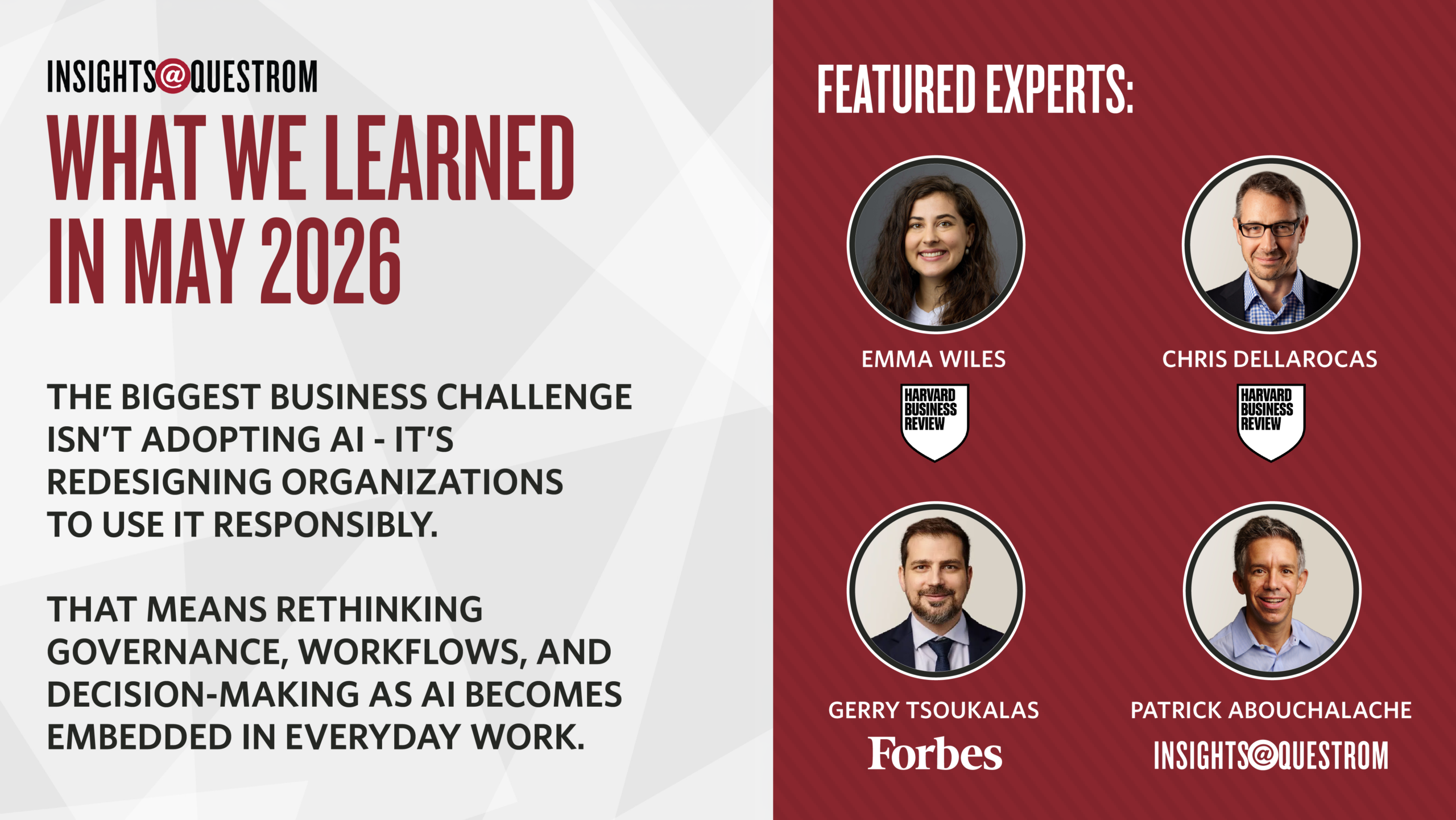
Artificial intelligence was the focus of several Insights@Questrom articles in May, spanning topics from AI agents and performance reviews to family business governance and human-AI collaboration. Despite their different perspectives, a common lesson emerged: the challenge facing organizations is no longer whether to adopt AI, but how to structure accountability, governance, and decision-making around it.
Here are four key insights from May:
Why You Shouldn’t Treat AI Agents Like Employees
Emma Wiles highlights research showing that treating AI agents like human teammates can reduce accountability, increase unnecessary review cycles, and create role confusion. Rather than humanizing AI, organizations should focus on designing workflows and governance structures that keep humans responsible for AI-supported work.
AI and the Future of Family Business
Patrick Abouchalache explores how family businesses can embrace AI while preserving the trust, values, and long-term stewardship that define them. Success depends on balancing innovation with strong governance, intergenerational communication, and thoughtful decision-making.
Gen AI Could Fix Performance Reviews—or Make Them Even Worse
Chris Dellarocas argues that AI’s greatest potential in performance reviews is not writing evaluations, but uncovering evidence of employee impact, collaboration, and decision-making. Used effectively, AI can help organizations build more transparent and evidence-based evaluation systems.
The Real Costs of AI Deployment Without Human Oversight
Gerry Tsoukalas highlighted the risks of deploying AI systems without meaningful human oversight. While AI can improve efficiency and decision speed, removing humans from critical points of judgment can create accountability gaps and unintended costs. Effective deployment requires clarity on where human involvement remains essential.
The Bigger Lesson
Across all four articles, one theme stood out: AI adoption is increasingly a management challenge rather than a technology challenge. Whether managing AI agents, integrating AI into family business governance, rethinking employee evaluations, or establishing appropriate oversight, success depends less on the technology itself and more on how organizations structure responsibility, accountability, and decision-making. As AI becomes embedded in everyday work, the organizations that thrive will be those that treat AI not simply as a tool, but as a catalyst for rethinking how work gets done.